
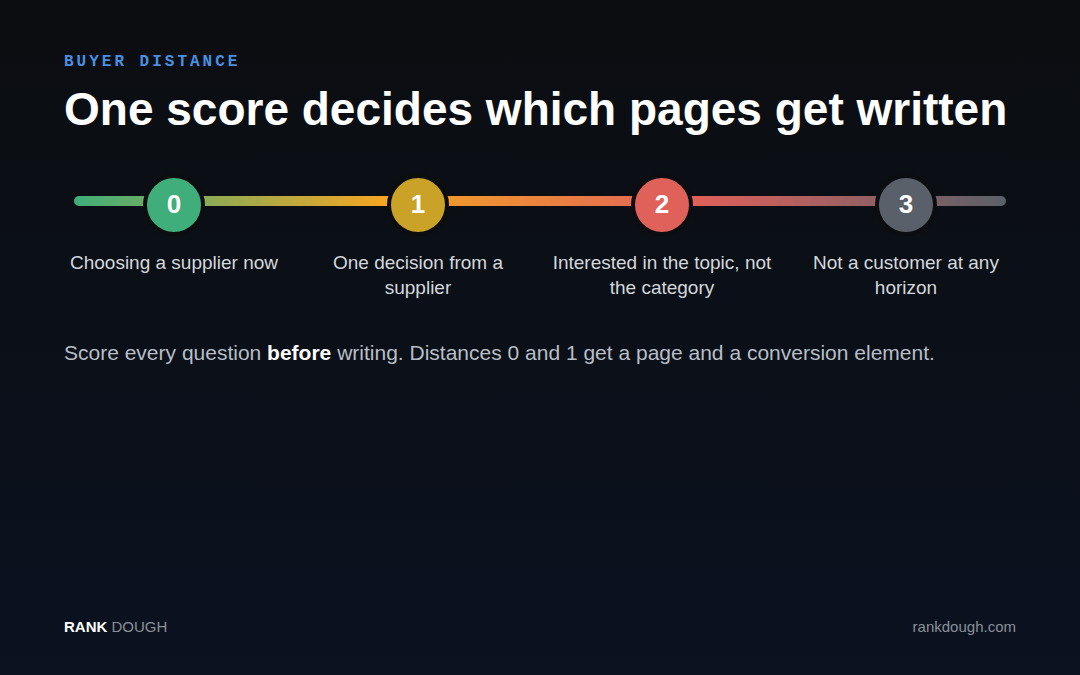
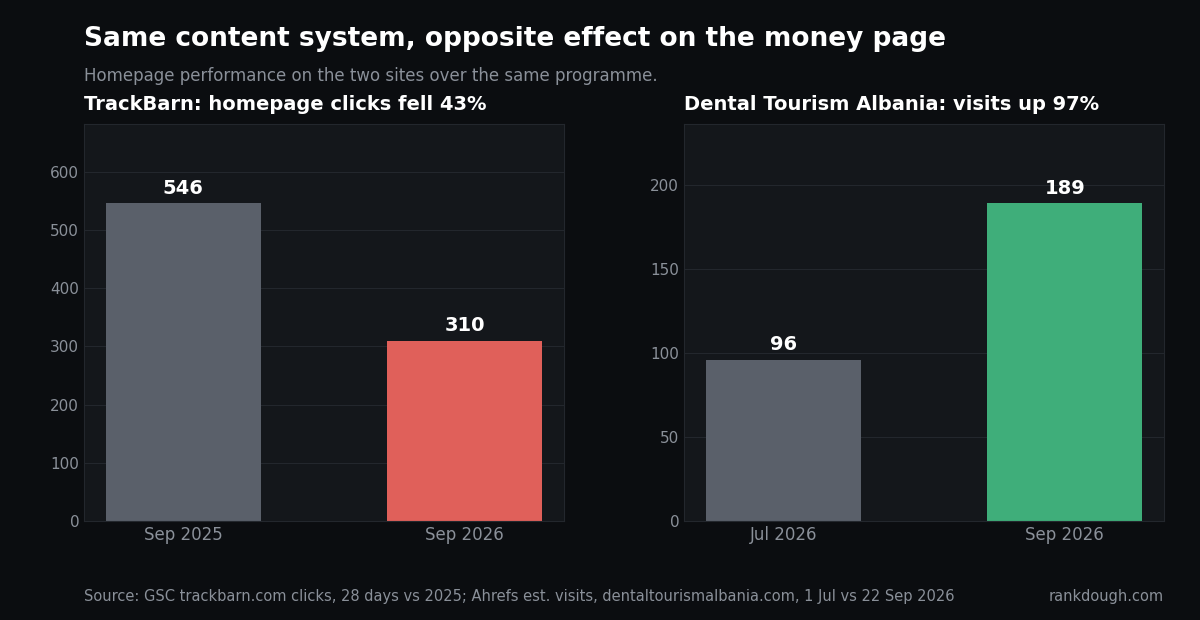
Buyer distance, the number of decisions between a searcher and the client’s product, explains why the same content lifted the dentaltourismalbania.com homepage from 96 to 189 estimated visits while the trackbarn.com homepage fell from 546 to 310 clicks.
TL;DR
The same content system and template produced opposite results on two clients’ homepages over six months: dentaltourismalbania.com rose from 96 to 189 estimated visits, while trackbarn.com fell from 546 to 310 clicks. The content was equally good on both. The difference is buyer distance, the count of decisions between the searcher and the client’s product, which I now score before writing any page.
How this was researched
The work behind the numbers, so you can judge them for yourself.
EFFORT
Six months, two clients
Six months of data from two client sites using the same content system, compared side by side.
ORIGINALITY
Our own comparison
Two live projects run by us. The buyer-distance score came out of this comparison.
SKILL
Run by an SEO, not a tool
Written by Roman Sadowski, who ran both projects.
ACCURACY
What it doesn’t prove
Two sites. Buyer distance is our reading of the difference, not the result of a controlled test.
The same system produced opposite outcomes for two clients
Between March and September 2026 both sites received several hundred question pages built to the same rules: answer-first opening with two numbers, atomic sections with sources, five FAQs, a table, schema. Both sets of pages reached page one inside 60 days.
Both sites saw impressions and page-one keywords grow several times over. On rankings the programmes are indistinguishable.
On the pages that earn money they are not. Ahrefs shows the dentaltourismalbania.com homepage gaining 93 estimated visits between 1 July and 22 September, and its head term “dental tourism albania” at position 2.
Clinic listing pages such as Elite Dental and DentalCare One rose on their brand terms. Search Console shows the trackbarn.com homepage at 310 clicks in the 28 days to 22 September against 546 in the same period a year earlier.
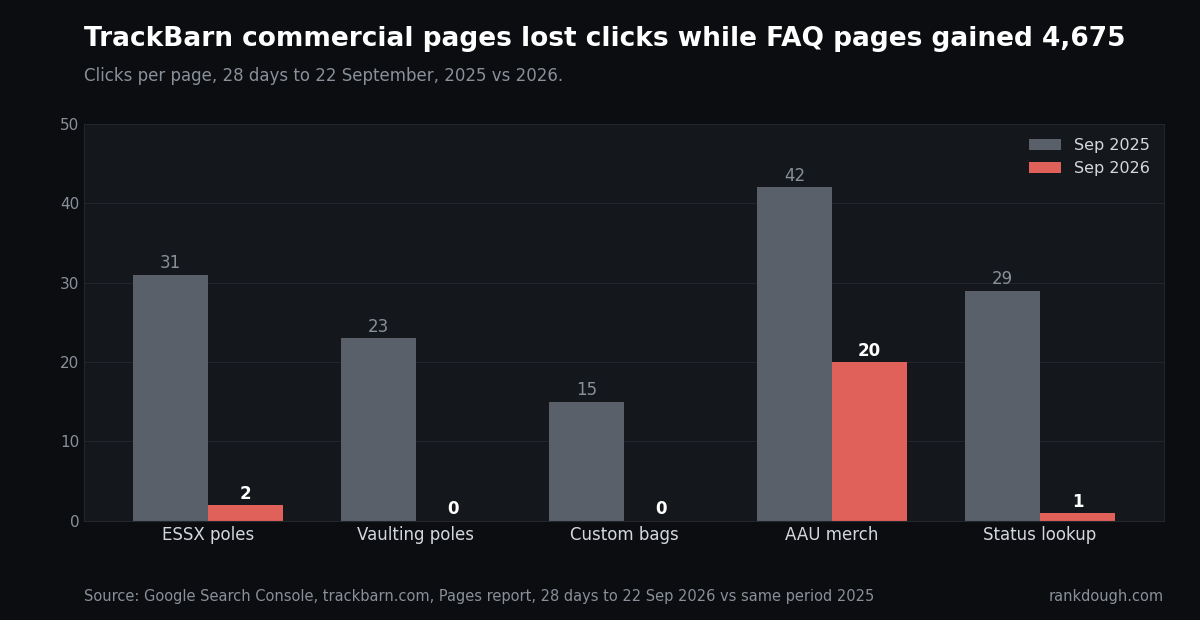
The ESSX poles collection went from 31 clicks to 2, vaulting poles from 23 to 0, custom bags from 15 to 0.
I cannot yet separate FAQ dilution from an independent product-page problem on TrackBarn; the 90-day view and a merchant listings check are in progress. But the contrast with the dental site is not explained by content quality, because the content was produced by the same rules. It is explained by who was asking the questions.
What does buyer distance measure?
Buyer distance is the number of decisions a searcher still has to make before they could buy what the client sells. It is scored per query, before a page is written, from 0 to 3.
- 0: the searcher is choosing between suppliers now. “Dental implants Albania cost”, “ESSX pole size chart”.
- 1: the searcher has a need and is one decision from a supplier. “When can you eat after tooth extraction” (they have had treatment; the next question is where to get the implant). “What to eat before a cross country race” (they run; they need gear).
- 2: the searcher is interested in the topic but not the category. “How does cross country scoring work”.
- 3: the searcher is not a customer at any horizon. “What is the javelin world record”. “How far does middle school cross country run” (the searcher is a parent, and the product is an $800 vaulting pole).
The dental FAQ pages that rank at positions 1 and 2 score 1. Aftercare readers are patients, and the site’s business is connecting patients to clinics.
The TrackBarn FAQ pages that earn the most clicks score 2 and 3. Parents and school runners do not buy pole vault equipment. The pages did exactly what they were built to do; they were built for the wrong distance.
What does the data show, page by page?
dentaltourismalbania.com, Ahrefs top pages, 22 September 2026:
- Homepage: 189 visits, up 93 since 1 July, “dental tourism albania” position 2
- “When can you eat after tooth extraction”: position 2 UK, 144 visits, buyer distance 1
- “Can I put orajel on my tooth extraction”: position 1 US, 44 visits, buyer distance 1
- Elite Dental clinic page: 26 visits, up 21; DentalCare One: 19 visits, up 10
trackbarn.com, Google Search Console, 28 days to 22 September 2026 versus the same period in 2025:
- Homepage: 310 clicks versus 546, position improved from 18.8 to 10.6
- ESSX poles collection: 2 clicks versus 31, position 15.8 versus 8.2
- Vaulting poles collection: 0 clicks versus 23
- “What is a good 5k time for cross country”: 255 clicks, position 4.3, buyer distance 2
- “How far does middle school cross country run”: 149 clicks, position 3.6, buyer distance 3
- “What is the javelin world record”: 67 clicks from 58,339 impressions, buyer distance 3
Total new-page clicks on TrackBarn: 4,675. Total clicks lost on the homepage and the three pole and bag collections: 302. The programme is a large net gain in traffic and, on the evidence so far, a net loss on the pages that sell.
How does the score change what gets written?
The score sits at the front of the pipeline, after keyword intake and before the research brief. Every candidate question gets a distance. Then:
- Distance 0 and 1 questions get a page, with a conversion element assigned before drafting: a price block, a clinic finder, a sizing tool, a product card, placed where the reader finishes the task.
- Distance 2 questions get a page only when the silo needs topical coverage to support the distance-1 pages, and they are measured as citation assets, not as traffic.
- Distance 3 questions are not written, however large the search volume. 58,339 impressions for a world record query is not a reason to publish; it is the reason the site’s average CTR fell.
Applied retrospectively to TrackBarn, the rule would have removed roughly a third of the 455 pages before they were written and given the remainder a product block. Applied to the dental site, it would have changed almost nothing, which is why that site’s money pages grew.
Why must the score come before the brief?
Once a research brief exists, the page gets written; that is how content operations work. The only point at which a bad question can be stopped cheaply is before research starts.
Putting the score at the front also fixes the conversion element early, so the writer knows where the page is going and can point the last section at it, instead of an agency bolting a call to action onto a finished article about javelin records.
What should you ask about your own content?
- Score your top 20 informational pages by clicks. How many sit at distance 2 or 3? On TrackBarn the answer is most of them.
- Compare money-page clicks year on year alongside the content report. If the content report is green and the money pages are red, the pages were written for the wrong distance.
- For every page at distance 1, name the conversion element. If there is none, the reader finishes the task and leaves.
FAQ
What is buyer distance?
The number of decisions between a searcher and a purchase from the client, scored 0 to 3 per query before a page is written. Pages are only written at distance 0 or 1 unless a silo needs support.
Why did the same content work on one site and not the other?
Dental aftercare readers are patients one decision from choosing a clinic. Cross-country trivia readers are parents and school athletes who do not buy pole vault equipment. The pages ranked equally well; the readers were at different distances.
Should high-volume distance-3 queries ever get a page?
Only as a deliberate brand-visibility play, measured by citations and branded search rather than clicks, and never at the expense of distance-1 coverage.
Is TrackBarn’s homepage decline caused by the FAQ pages?
Not established. Homepage position improved while clicks fell, and the pole collections lost position independently. A 90-day view and a merchant listings check are in progress before I attribute the cause.
What is a conversion element?
A block the reader needs to complete the task the page answers: a price table, a clinic finder, a sizing tool, a product card. It is assigned before drafting, not appended after.
Sources
- Google Search Console, trackbarn.com, Pages report, 28 days to 22 September 2026 versus same period 2025
- Ahrefs Site Explorer, top pages, dentaltourismalbania.com, 22 September 2026 compared with 1 July 2026
