
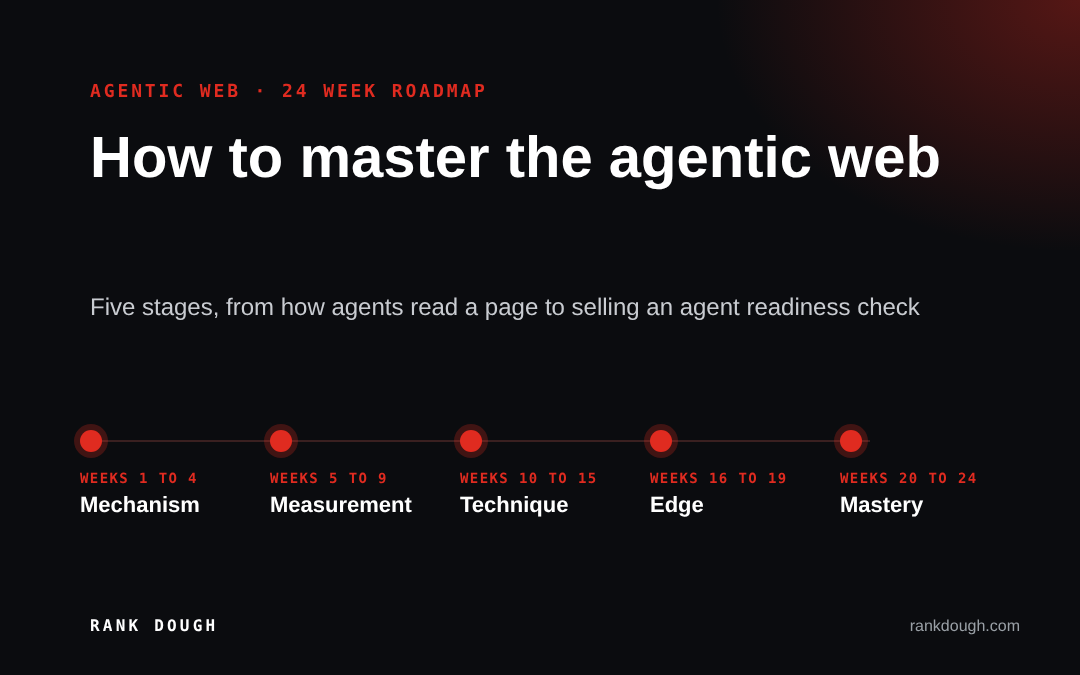
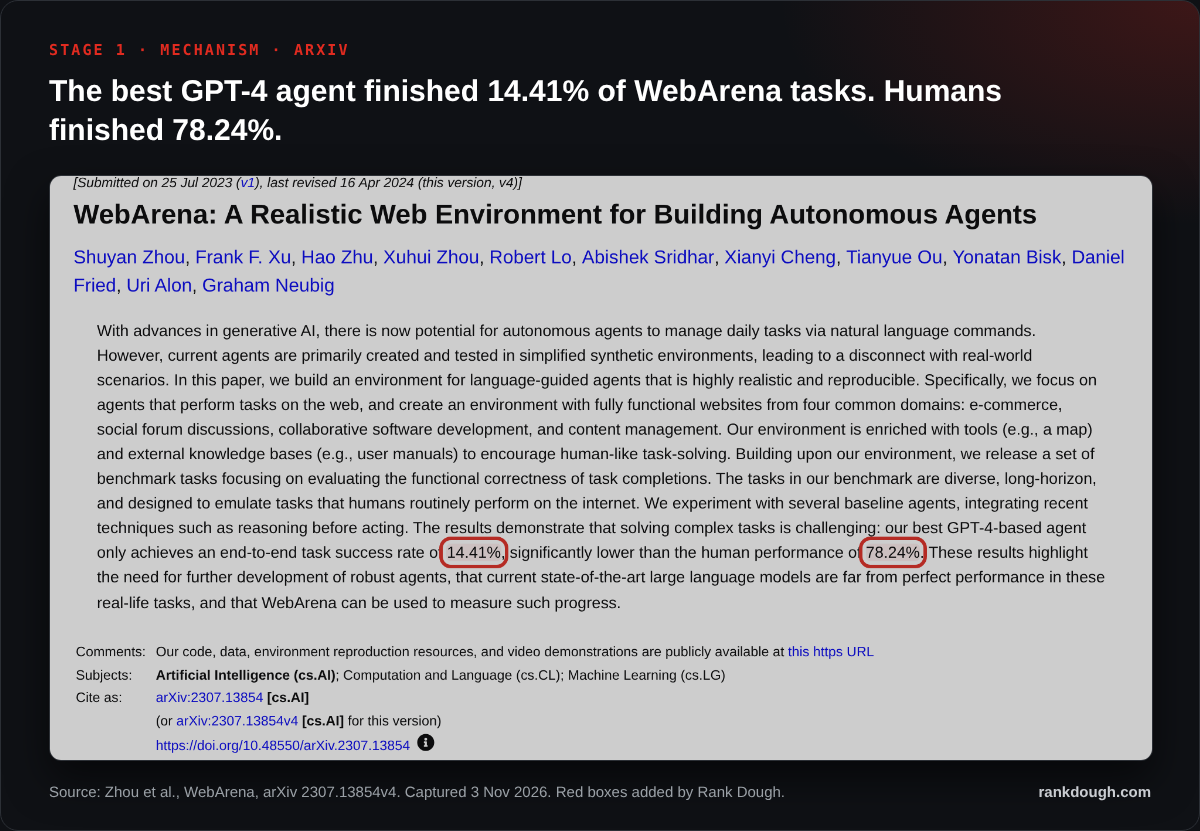
You master it in five stages over about 24 weeks, and Rank Dough built this roadmap from 17 sources we opened and checked on 3 November 2026. It starts with how an agent reads a page, because the best GPT-4 agent in the WebArena benchmark finished only 14.41% of web tasks while humans finished 78.24%.
TL;DR
The agentic web is the web used by AI agents that browse, compare, fill forms, book and pay for people, plus the standards that let sites talk to them. This roadmap takes an experienced SEO from how agents read a page to selling an agent readiness check in five stages: Mechanism, Measurement, Technique, Edge and Mastery, at 3 to 5 hours a week. Each stage has a skill to learn, the sources worth reading, one drill on a real site and one piece of proof that shows the stage is done.
How this was researched
The work behind the numbers, so you can judge them for yourself.
EFFORT
17 sources, each opened
On 3 November 2026 we opened, dated and checked every paper, specification and post in this roadmap. Anything we couldn’t open was cut.
ORIGINALITY
Built for SEOs, not engineers
The stage order, the drills and the proof for each stage are Rank Dough’s own, tied to our agent tests on a live site and on Currys UK.
SKILL
Written by the SEO lead
Roman Sadowski set the stages and the drills from twenty years of SEO work and the agent tests he ran on 3 November 2026.
ACCURACY
What it doesn’t prove
It’s a learning plan, not a measured method. Nobody has run all 24 weeks yet, and the standards may change after 3 November 2026.
What is the agentic web?
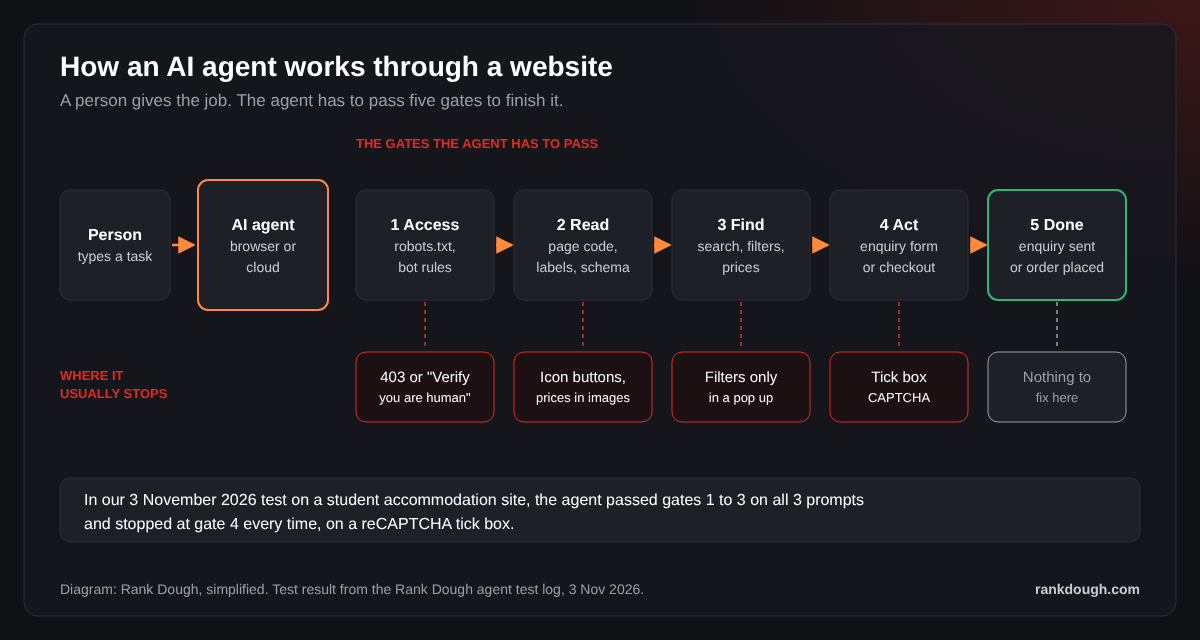
The agentic web is the web used by an AI agent on a person’s behalf. You tell the agent “find me a studio near the university under a set budget and send an enquiry”, and the agent does the browsing, the comparing and the form.
That changes what success means for a website. A person reads the design and the copy. An agent reads the code: labels, buttons, structured data and the form itself.
| Question | Today’s web | Agentic web |
|---|---|---|
| Who visits | A person | An agent sent by a person |
| What it reads | Design and copy | Labels, buttons, structured data |
| What counts as success | A click or a visit | The task done: booked, enquired, bought |
| Where it fails | Poor UX | CAPTCHAs, unlabelled buttons, bot blocking |
SEO has always been about getting found. On the agentic web, getting found isn’t enough. The agent also has to finish the job, and I see that as the part most sites haven’t tested yet.
How is the roadmap laid out?
The roadmap runs in five stages, and each one needs the one before it. It assumes 3 to 5 hours a week and an SEO who already knows the basics, so it skips beginner material on purpose.
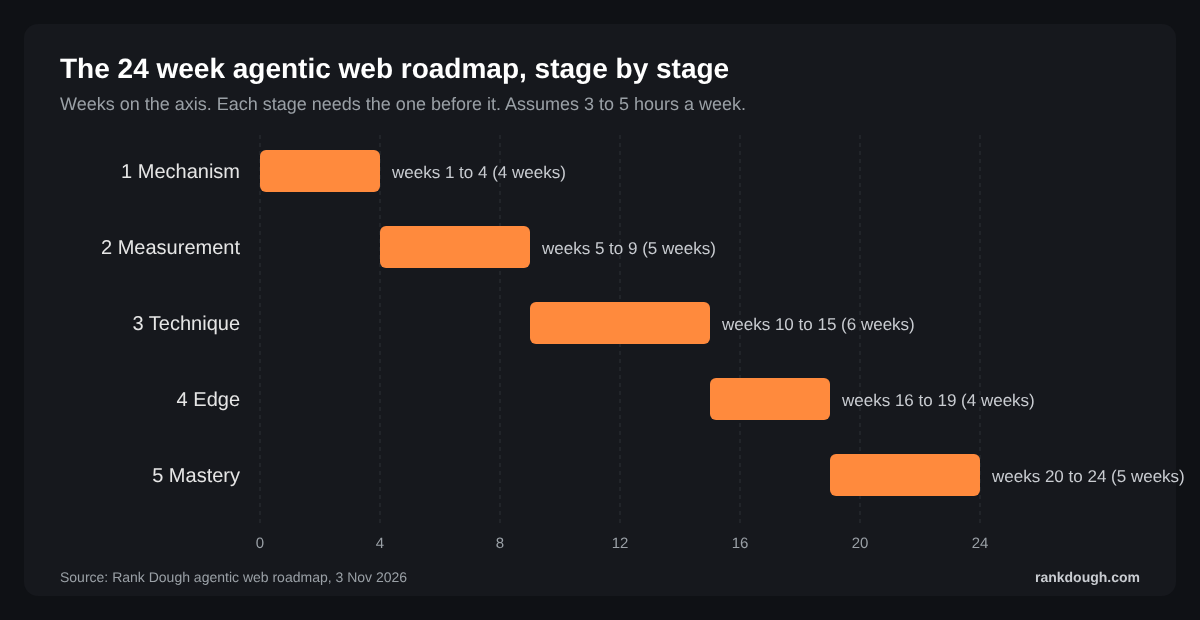
| Stage | Outcome | Proof | Weeks |
|---|---|---|---|
| 1 Mechanism | Explain agent failure from the agent’s side | Three task teardowns on a live site | 1 to 4 |
| 2 Measurement | Count agent visits and finished tasks | Agent traffic panel, 4 weeks of data | 5 to 9 |
| 3 Technique | Pick and ship the right standard | One live WebMCP or NLWeb pilot, checklist on 2 sites | 10 to 15 |
| 4 Edge | Defend a view on each open fight | Position paper and 5 posts | 16 to 19 |
| 5 Mastery | Sell and predict | One audit, one case note, 10 scored calls | 20 to 24 |
Source: Rank Dough agentic web roadmap, 3 November 2026.
We built it in a fixed order: Rank Dough’s own notes and tests first, then the live web for primary sources, then every source opened before it went in. Anything we couldn’t open and date was cut.
Where should you start? The skip test
Answer five questions without looking anything up. Every one you get right lets you skip ahead, so you don’t spend weeks on what you already know.
TICK WHAT YOU CAN ANSWER
WHERE TO START
The starting point is Rank Dough’s judgement, not a scored test. Without JavaScript, the rule is:
- Four or five answered: start at Stage 3.
- Two or three answered: start at Stage 2.
- One or none: start at Stage 1.
Stage 1: how does an agent read, decide and act?
You’ll be able to: explain to a client, from the agent’s side, why their booking flow fails an agent when a person gets through it. Time box: weeks 1 to 4.
World class techniques
- Read the page as the agent does. Agents work from a mix of the page code, the accessibility tree and screenshots. OpenAI says its Atlas browser uses ARIA roles and labels to read page structure. It fails where the agent works from screenshots only. Established.
- Map the task, not the page. Score a site on whole tasks (find, compare, enquire, pay), the way WebArena and WebMall do, not page by page. It fails on sites with one simple action. Established.
- Separate the three traffic types. Training crawlers, search crawlers and agents acting for a user behave differently and need different rules. Established.
| Resource | Why most SEOs miss it | What to take from it |
|---|---|---|
| WebArena, Zhou et al., Jul 2023 (v4 Apr 2024) | A research benchmark, not an SEO article | Best GPT-4 agent 14.41% vs humans 78.24%. Read the failure analysis, not the score. |
| Mind2Web, Deng et al., Jun 2023 | Written for model builders | Over 2,000 tasks on 137 sites. Agents worked better when raw HTML was filtered first, so your markup is the input. |
| WebMall, Peeters, Bizer et al., Aug 2025 (v3 Apr 2026) | Academic, from Mannheim | Comparison shopping across shops. Best agents under 65% on cheapest product and vague search. The closest benchmark to retail. |
| WAI-ARIA Authoring Practices, W3C | It’s an accessibility guide | Accessibility patterns are the agent’s map of buttons, menus and forms. |
Sources: arXiv papers above; W3C WAI; OpenAI Publishers and Developers FAQ, checked 3 November 2026.
Unconventional approach: learn from accessibility first. Run a screen reader through a client’s enquiry form before any agent. Where the screen reader stalls, the agent usually stalls too. That’s a hypothesis, and the drill tests it.
Drill: pick three tasks on a live site you work on: find an item under a budget, compare two items, start an enquiry. Run each with an agent and with a screen reader, and log where each one fails.
Proof of mastery: a one page “why the agent failed” teardown per task, each failure tied to a cause: a missing label, a CAPTCHA, a choice lost from the web address, or a control that only works in JavaScript.
Stage 2: how do you see agents on a live site?
You’ll be able to: show a client how many agent visits they get, which tasks agents attempt and how many finish. Time box: weeks 5 to 9.
World class techniques
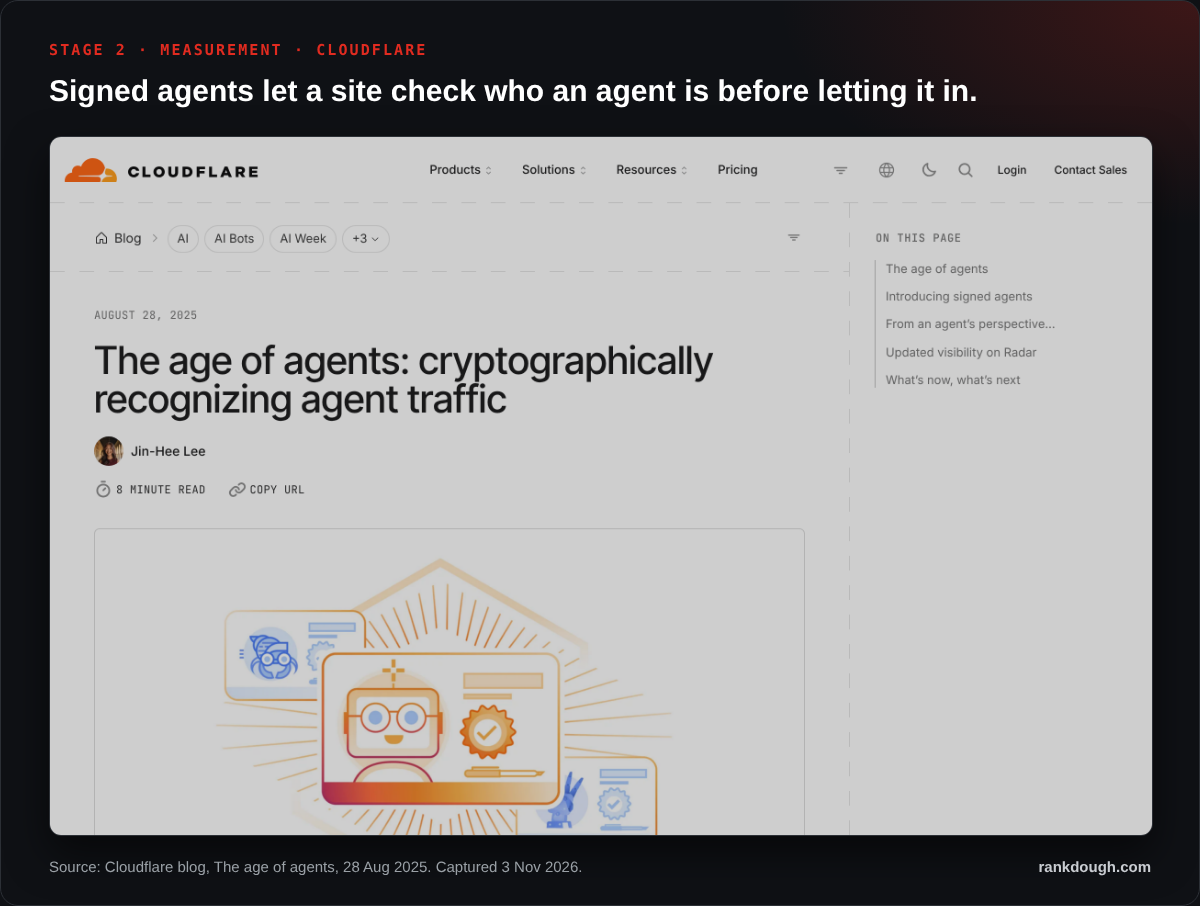
- Verify, don’t guess from user agents. Signed agents sign each request with HTTP Message Signatures, and the site finds the key through a Signature-Agent header. It fails for agents driving the user’s own browser, which look human. Established.
- Split the logs by purpose. Tag every AI hit as training, search, user action or undeclared, using Cloudflare’s four groups. Cloudflare measured crawl to refer ratios of about 887 to 1 for OpenAI and 50,000 to 1 for Anthropic in early August 2025. Established.
- Measure task success, not visits. An agent visit that ends at a CAPTCHA is a lost lead. Build an agent funnel: landed, found the item, reached the form, submitted. Hypothesis, because there’s no public benchmark for live sites yet.
| Resource | Why most SEOs miss it | What to take from it |
|---|---|---|
| HTTP Message Signatures for automated traffic, Meunier (Cloudflare) and Major (Google), IETF draft, Mar 2026 | It’s a standards draft | How a site checks who an agent is. Read the key directory part. |
| The age of agents, Jin-Hee Lee, Cloudflare, Aug 2025 | Filed under security, not marketing | Which agents sign today and the rules they have to meet. |
| A deeper look at AI crawlers, David Belson, Cloudflare, Aug 2025 | Read for the headline, not the method | The four purpose groups and the crawl to refer ratios by industry. |
| Your own raw server logs | Nobody sells them to you | The ground truth no tool gives you. |
Sources: IETF datatracker; Cloudflare blog, checked 3 November 2026. The IETF draft has since been replaced by a newer version.
Unconventional approach: build the tool. A small script that reads raw logs, labels each AI hit by purpose and signature, and pushes a weekly table to a dashboard. Building it teaches you what can and can’t be seen.
Drill: run an agent test on a live site before and after a change to its bot settings. Compare verified agent hits, form reaches and submissions.
Proof of mastery: an agent traffic panel on one live site with four weeks of data, labelled by purpose, with the agent funnel next to it.
Stage 3: how do you make a site agent ready?
You’ll be able to: tell a client which standard fits their business in one line, and ship the first piece. Time box: weeks 10 to 15.
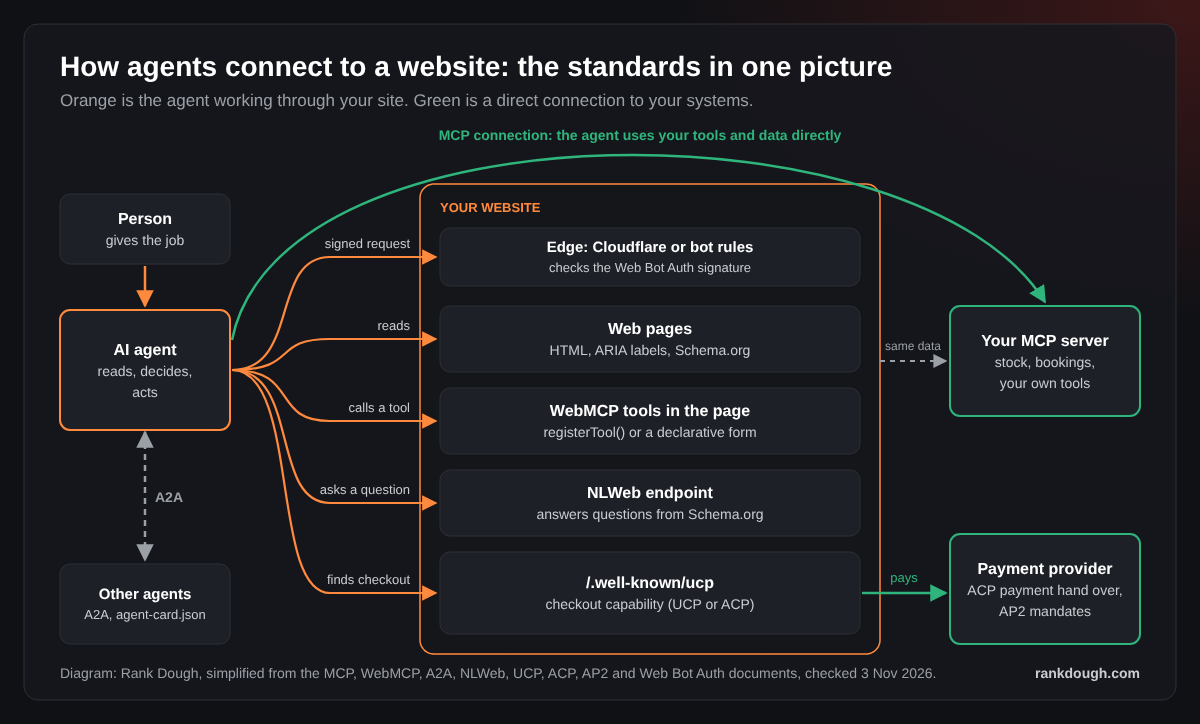
| Standard | What it connects | Who is behind it | Where it lives | Status, 3 Nov 2026 |
|---|---|---|---|---|
| MCP | Agent to tools and data | Anthropic, open | A server the agent connects to | Stable revision 2026-07-28 |
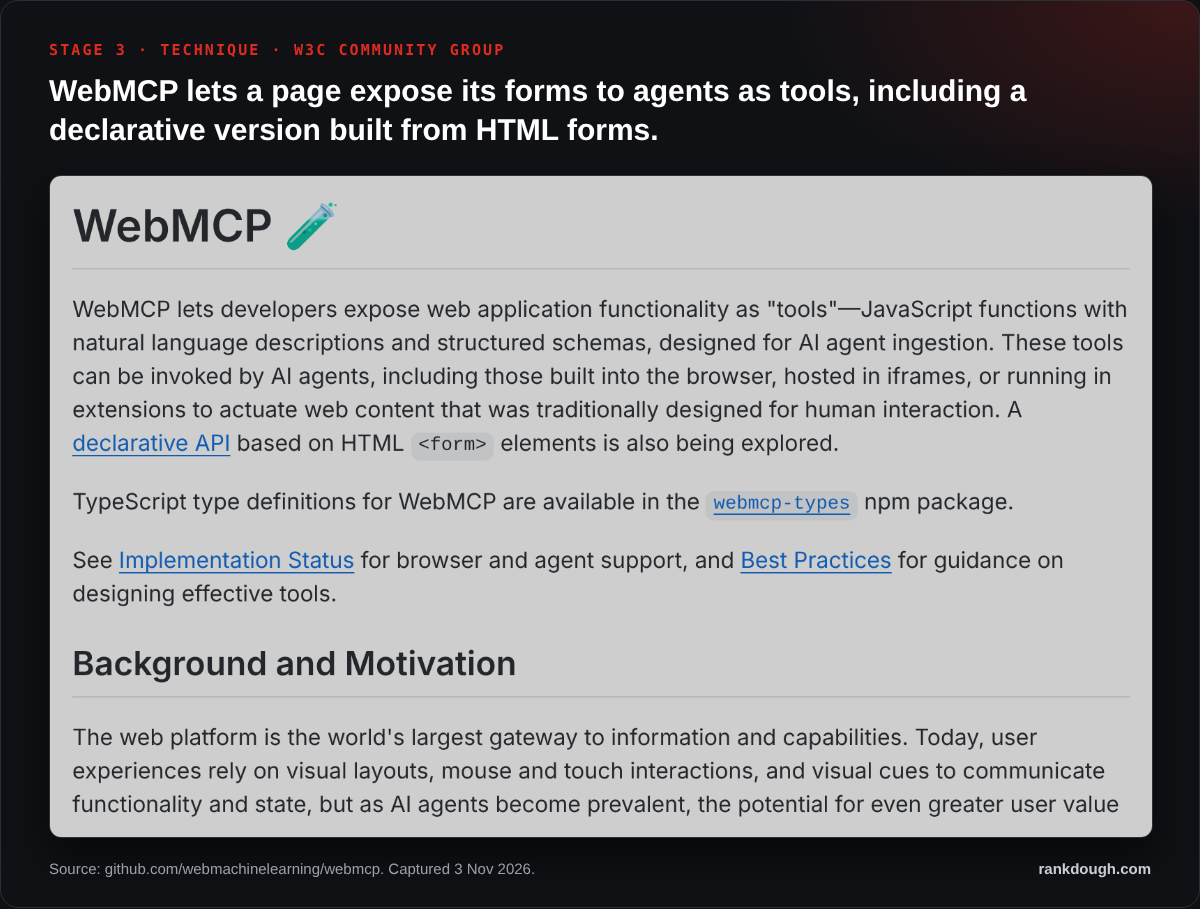
| WebMCP | Page to the agent in the tab | W3C community group, Microsoft and Google authors | A script on the page, plus declarative forms | Draft, early preview in Chrome |
| A2A | Agent to agent | Google, given to the Linux Foundation | /.well-known/agent-card.json | Version 1.0.0 |
| NLWeb | Site answers questions in plain language | Microsoft, R.V. Guha | Built on Schema.org and RSS | Open source since May 2025 |
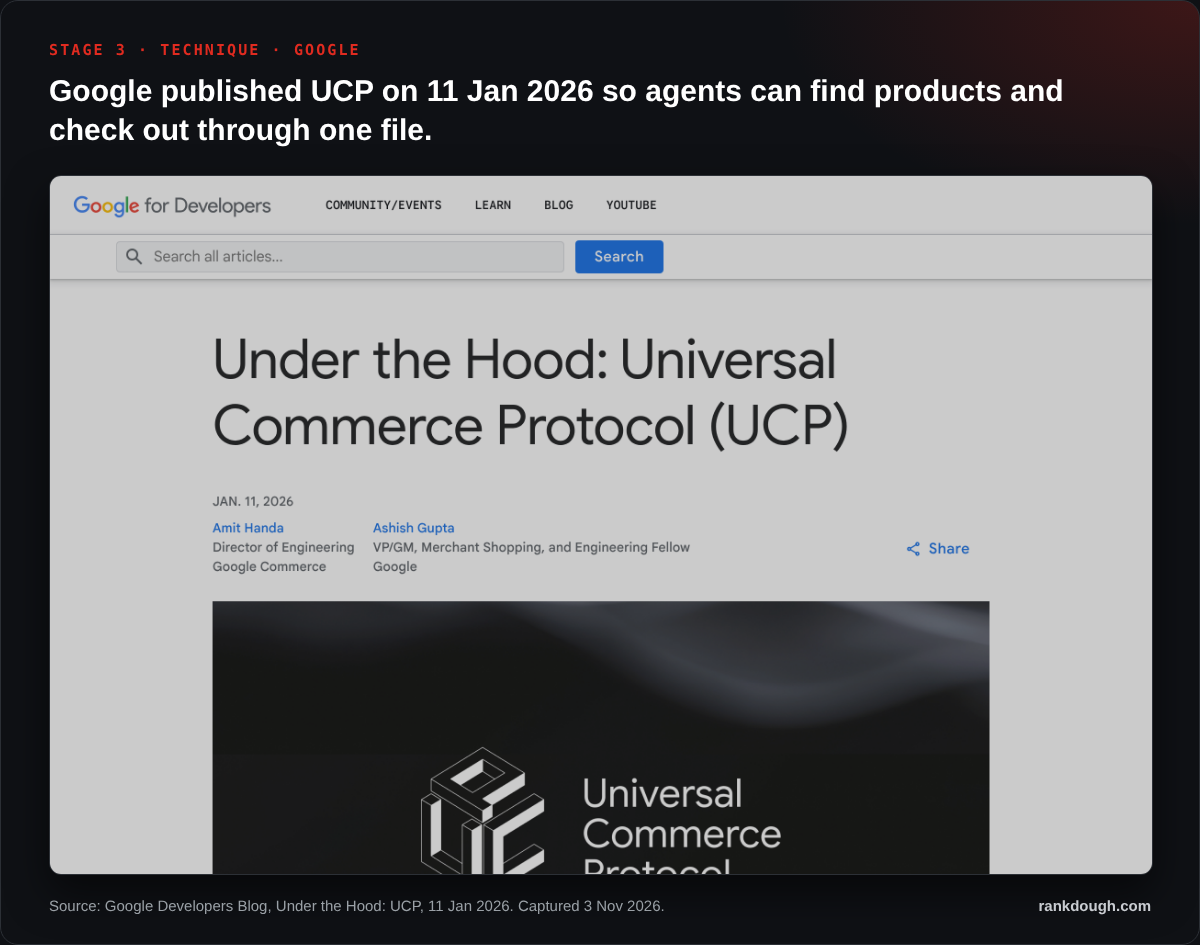
| UCP | Discovery to checkout to orders | Google with Shopify, Etsy, Wayfair, Target, Walmart | /.well-known/ucp | Published 11 Jan 2026 |
| ACP | Checkout and payment hand over | Stripe, OpenAI and Meta | REST or MCP | Spec dated 2026-04-17 |
| AP2 | What the shopper allowed the agent to spend | Google, open | Signed mandates | Open extension |
Sources: the specification pages linked in the table, all checked 3 November 2026. Chrome status from Daniel Vaughan’s October 2026 write up.
World class techniques
- Schema first, standard second. NLWeb reads Schema.org, so clean structured data is the cheapest agent work and pays off in search too. Established for NLWeb, a hypothesis for other agents.
- Fix the form before adding a standard. Labelled fields, ARIA roles, choices kept in the web address, and no tick box CAPTCHA for verified agents. In our Cloudflare agent test the agent failed on a reCAPTCHA tick box, not on a missing standard. Practitioner evidence, one test.
- Pilot WebMCP on one form. Wrap a single enquiry form as a declarative WebMCP tool. It’s cheap, you can undo it, and few sites have tried it. It does nothing today in a browser without the preview switched on. Hypothesis.
- Shops: pick UCP or ACP by platform. Shopify merchants get UCP through Shopify. Stripe merchants have the ACP route. Don’t build both. Practitioner evidence, vendor documents only.
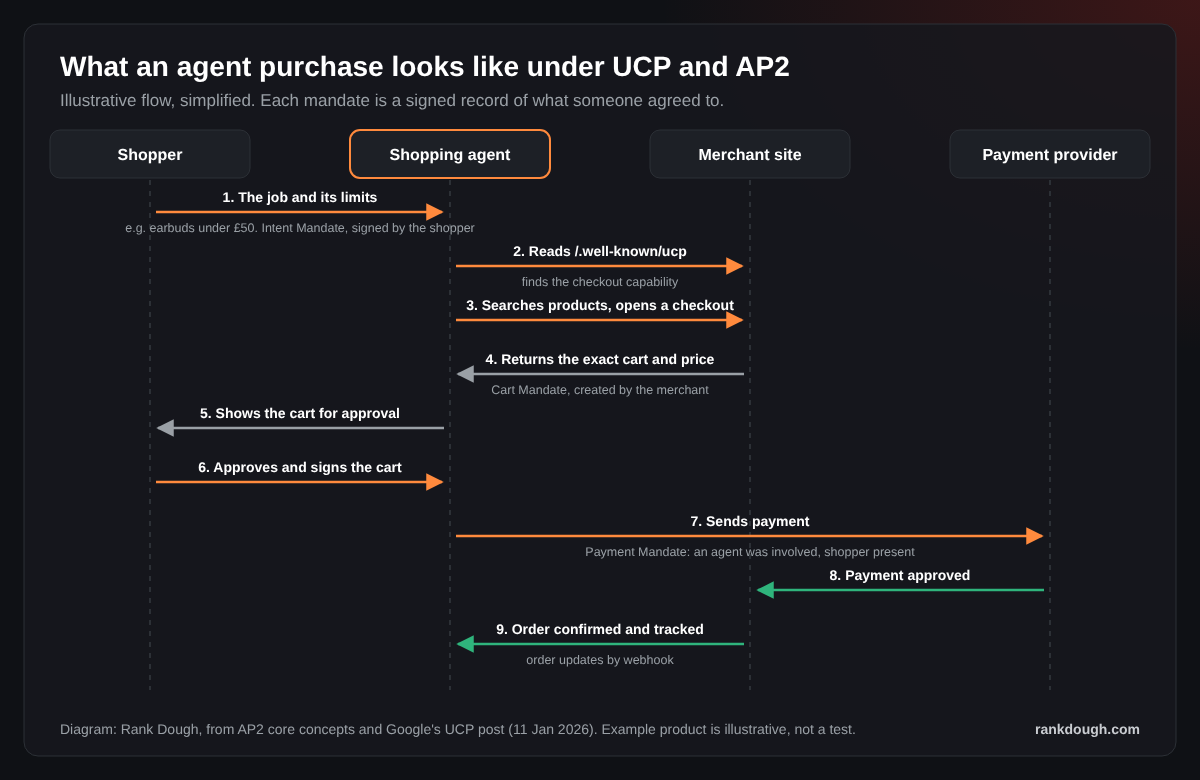
Unconventional approach: break it on purpose. On a test page you own, ship a WebMCP form tool, then remove the labels, then add a CAPTCHA. Run the same agent each time and watch what it does.
Drill: write an agent readiness checklist (crawl access, a rule for verified agents, ARIA, schema, the form, the /.well-known files) and run it on two real sites.
Proof of mastery: one live WebMCP or NLWeb pilot on a site you own, and the checklist scored on two real sites.
Stage 4: where do the experts disagree?
You’ll be able to: hold a view on each open fight and say where it breaks. Time box: weeks 16 to 19.
- Who owns it. John Mueller asked the question on LinkedIn and Joe Hall answered it: SEO owns discovery and understanding, developers own login, payments and APIs. Natzir Turrado’s AX idea, agent experience next to UX, pushes it towards a new role. Your view should name which half you sell.
- ARIA for agents. OpenAI asks sites to add ARIA so Atlas can act. Adrian Roselli argues this invites ARIA keyword stuffing that hurts people who use screen readers. Read both.
- Block or let in. Training crawlers give little back, with crawl to refer ratios in the hundreds to tens of thousands. Agents acting for a user bring buyers. One blanket rule is wrong for most businesses. That’s my reading of Cloudflare’s data.
- Three checkout standards. UCP, ACP and AP2 overlap and nobody knows which wins. Treat any client spend here as a small bet you can undo.
- WebMCP adoption. It’s still a draft in an early Chrome preview, and the API name has already changed once. Early pilots may need rewriting.
Unconventional approach: read against yourself. For each fight, write your view in three lines, then find the strongest source against it and rewrite.
Drill: one LinkedIn post per fight for business owners, one a fortnight. Track which ones draw objections and from whom.
Proof of mastery: a one page position paper, “What we do and don’t do on the agentic web”, with each claim labelled established, practitioner evidence or hypothesis.
Stage 5: how do you teach, sell and predict it?
You’ll be able to: sell an agent readiness check, run it with an agent, and make calls on the market that come true more often than not. Time box: weeks 20 to 24.
- Turn the checklist into a service. An agent readiness check: an agent task test, a rule for verified agents, form fixes, schema and one standard picked. Hypothesis, because demand isn’t tested yet.
- Publish proof, not opinion. Anonymised agent tests on real sites are what most agencies don’t have. Each one becomes a short case note.
- Keep a prediction log. Ten dated calls, for example “WebMCP reaches stable Chrome by a set date” or “a top Irish retailer publishes /.well-known/ucp”. Score them every quarter.
Unconventional approach: ask the builder. Send one precise question to a WebMCP author or an A2A steering committee member, for example how agents should handle a step that needs a verified human. Publish the answer with permission.
Drill: run one agent readiness check end to end for a warm prospect, with an agent doing the task test.
Proof of mastery: one paid or signed off check, one published case note, and a prediction log with at least ten scored calls.
What should a prediction log look like?
Five columns are enough. Write the call before you check it, and never edit a row after the date passes.
| Date | Call | Expected by | Actual | What changes |
|---|---|---|---|---|
| Date you wrote it | One sentence anyone can check | A date | Filled in on the date | What you’d tell a client now |
The point is honesty with yourself. The reality is this: most predictions about the web sound right when you make them and nobody checks them later.
What doesn’t this roadmap prove?
It’s a learning plan, not a measured method. The order of stages and the time boxes are Rank Dough’s judgement, and no one has run all 24 weeks end to end yet.
The standards change fast. Every status in the Stage 3 table is dated 3 November 2026, and WebMCP in particular may look different in a few months. The screen reader link in Stage 1 and the agent funnel in Stage 2 are hypotheses until they’re measured on live sites.
Frequently asked questions about the agentic web roadmap
What is the agentic web?
The agentic web is the web used by AI agents that browse, compare, fill forms, book and pay on a person’s behalf, plus the standards that let sites talk to them, such as MCP, WebMCP, A2A, UCP, ACP and AP2.
How long does it take to learn the agentic web?
This roadmap takes about 24 weeks at 3 to 5 hours a week, in five stages: Mechanism, Measurement, Technique, Edge and Mastery. The skip test lets an experienced SEO start at Stage 2 or 3.
Do I need to add WebMCP to my site now?
Not yet for most sites. As of 3 November 2026 WebMCP is a draft in an early Chrome preview. Fix the form, the labels and the structured data first, then pilot WebMCP on one form if you want to be early.
How do I see AI agents in my analytics?
Most agents don’t show clearly in analytics. Check raw server logs, label each AI hit as training, search, user action or undeclared, and look for signed agents. Agents driving a person’s own browser look like that person.
Is the agentic web part of SEO?
Partly. SEO owns whether an agent can find and understand a site. Developers own logins, payments and forms. Someone has to test the hand over from the first search to the submitted form.
Sources
- Rank Dough agentic web roadmap research, 17 sources opened and checked on 3 November 2026
- Zhou et al., WebArena: A Realistic Web Environment for Building Autonomous Agents, arXiv 2307.13854v4: arxiv.org/abs/2307.13854v4
- W3C Web Machine Learning community group, WebMCP: github.com/webmachinelearning/webmcp
