
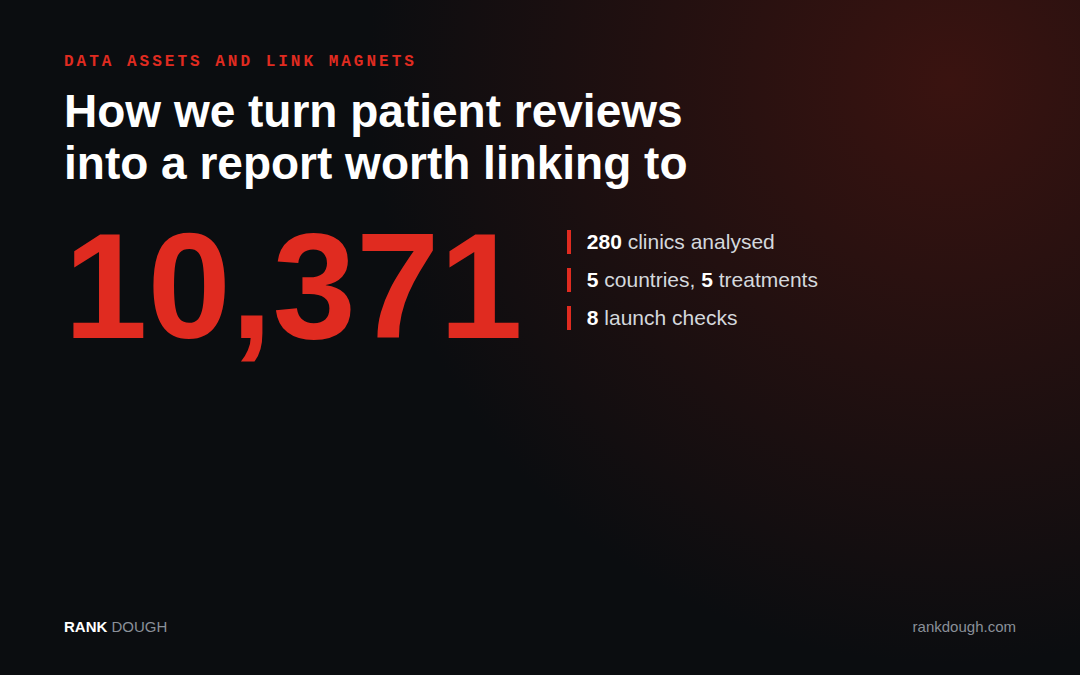
Rankdough builds a data report that earns links in three stages: collect a dataset nobody else has, turn it into 5 quotable numbers, then pass 8 launch checks so search engines and AI tools can read it. For Dental Tourism Albania that meant 10,371 patient reviews from 280 clinics in 5 countries, built into The State of Dental Tourism 2026 in 18 days, from 14 April to 1 May 2026.
TL;DR
A data report earns links because it gives journalists, writers and AI answers a number they can only get from you. The State of Dental Tourism 2026 turned 10,371 Trustpilot reviews of 280 clinics into country scores: Turkey led on volume with 7,628 reviews, Albania reached 95% positive sentiment and Poland had 40% negative reviews. Our October 2026 audit found 0 words of body text before JavaScript and 0 ranking keywords, which is why Rankdough now runs 8 launch checks before any data asset goes live.
How this was researched
The work behind the numbers, so you can judge them for yourself.
EFFORT
10,371 reviews, 280 clinics
Trustpilot reviews of 280 clinics in five countries collected and analysed into country scores, with the report app built between 14 April and 1 May 2026.
ORIGINALITY
A dataset nobody else had
No one had compiled clinic reviews across these countries before. That’s what makes it worth linking to.
SKILL
Run by an SEO, not a tool
Run by Roman Sadowski for a dental tourism client, including the October 2026 audit of why the report wasn’t ranking.
ACCURACY
Limits of the data
Trustpilot reviewers choose to review, so this is sentiment, not a clinical outcome measure. The audit found the report invisible to search before the fixes.
Why build a data report instead of another blog post?
A data report earns links because it is the original source of a number. A blog post repeats what already ranks; a report gives writers something to quote and a reason to credit you. For a young marketplace competing with large clinics and health sites, that is the fastest route to authority.
- Links and mentions: journalists covering dental tourism need comparisons between countries, and a 10,371-review dataset gives them one.
- Information gain: Google’s guidance asks whether content provides original information, research or analysis. A first-party dataset answers that question directly.
- AI citations: the GEO study by Aggarwal and colleagues found that adding statistics, quotations and citations can raise a source’s visibility in generative engine answers by up to 40%.
- Lead generation: a patient deciding between Turkey and Albania is the exact buyer the client wants, and the report answers their comparison question.
Source: Google Search Central, Creating helpful, reliable, people-first content; Aggarwal et al., GEO: Generative Engine Optimization, arXiv:2311.09735.
What did The State of Dental Tourism 2026 find?
The report found that Turkey dominates on volume and satisfaction, Albania matches it on sentiment at a fraction of the size, and Spain and Poland split patients far more sharply. Every figure below comes from the published report.
| Country | Reviews analysed | Average rating | Positive sentiment |
|---|---|---|---|
| Turkey | 7,628 | 4.82 / 5 | 96% |
| Albania | 698 | 4.78 / 5 | 95% |
| Hungary | 673 | 4.75 / 5 | 94% |
| Spain | 813 | 3.53 / 5 | 63% |
| Poland | 559 | 3.32 / 5 | 57% |
Methodology: the report uses public Trustpilot reviews of 280 clinics, filtered to those mentioning a dental treatment, translated to English where needed, then classified by treatment, sentiment and theme. The report is published by Dental Tourism Albania, a marketplace for clinics in Albania, and Turkey’s review collection was capped so the dataset totals just over 10,000 reviews.
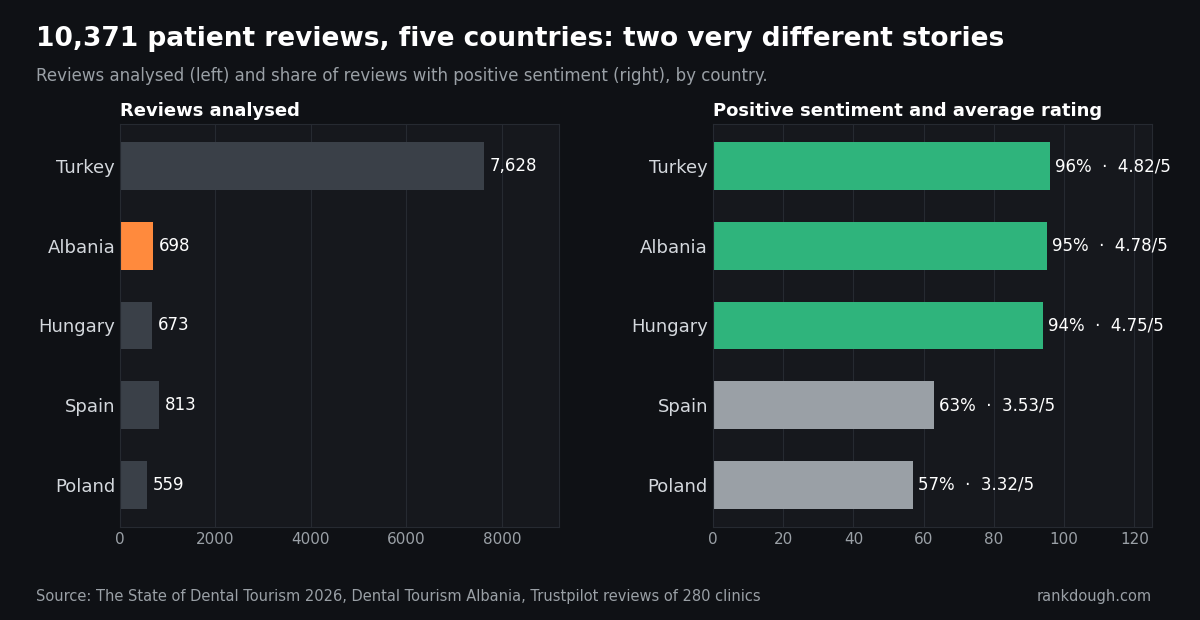
Source: Dental Tourism Albania, The State of Dental Tourism 2026, Trustpilot reviews of 280 clinics.
How was the data collected and checked?
The data runs through six steps, each a separate function in the app. The app was built in Lovable on a Supabase database between 14 April and 1 May 2026.
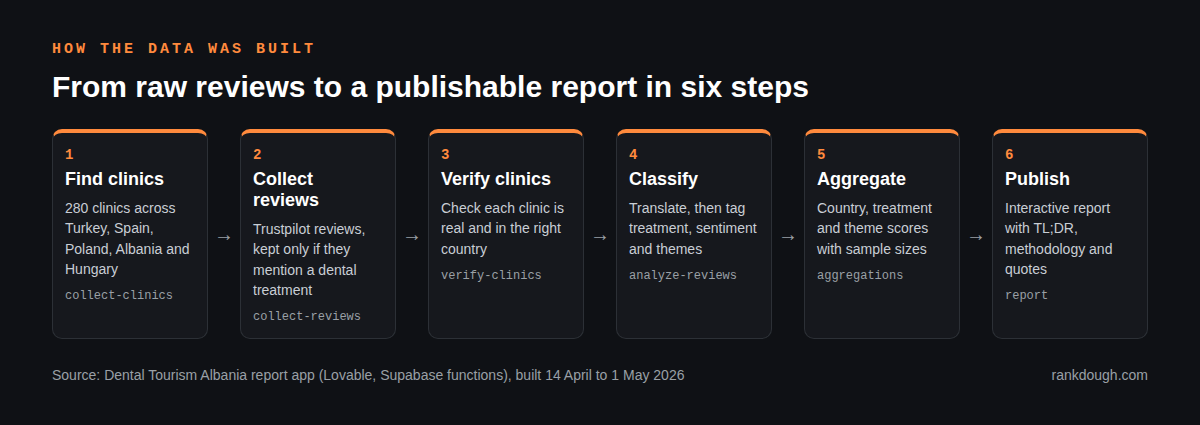
- Find and verify clinics: 280 clinics across five countries, each checked to confirm it is a real clinic in the right country before its reviews count.
- Collect and filter reviews: only reviews that mention a dental treatment stay in the dataset.
- Classify: each review is tagged by treatment, sentiment and recurring themes such as professionalism, trust and aftercare.
- Show the sample size: every country, treatment and theme score in the report carries its n, so readers can judge how much weight it holds.
Source: Dental Tourism Albania report app, Lovable project and Supabase migrations dated 14 April to 1 May 2026.
What makes a data point worth linking to?
A linkable data point is short, specific and slightly surprising, and it has to survive a journalist checking it: rank by the measured scores, show the sample size and say who published the data. The report produced several numbers a writer can drop into a sentence without context.
| Data point | Number | Why a writer would use it |
|---|---|---|
| Most praised theme across all countries | 8,973 mentions of professionalism | Explains what patients value most abroad |
| Most complained-about theme | 646 mentions of professionalism | The same word wins and loses patients |
| Poland’s negative share | 40% of reviews | A clear warning for price-led choices |
| Albania’s positive share | 95% of 698 reviews | A new market matching Turkey on sentiment |
| Turkey’s share of all reviews | 7,628 of 10,371 | Shows how dominant one market is |
Source: Dental Tourism Albania, The State of Dental Tourism 2026, theme analysis.
How does a data report work as a lead magnet?
A data report becomes a lead magnet when it answers the decision a buyer is about to make and then hands them to the page that sells. The State of Dental Tourism 2026 compares the five countries a patient is choosing between, ranks them by treatment, and shows real patient quotes from Albanian clinics.
- Answer the decision: “Which country is safest for implants?” is a buying question, and the treatment leaderboard answers it with sample sizes.
- Keep the buyer moving: each finding should link to the matching treatment page, such as implants, All-on-4 or veneers.
- Make it shareable: a named report with an edition number gets passed around forums and Facebook groups in a way a service page never will.
What stops a data asset from being found?
Technical setup stops most data assets from being found, not the data. Rankdough’s audit of the report in October 2026 showed exactly that: the content is strong, but crawlers could not read it.
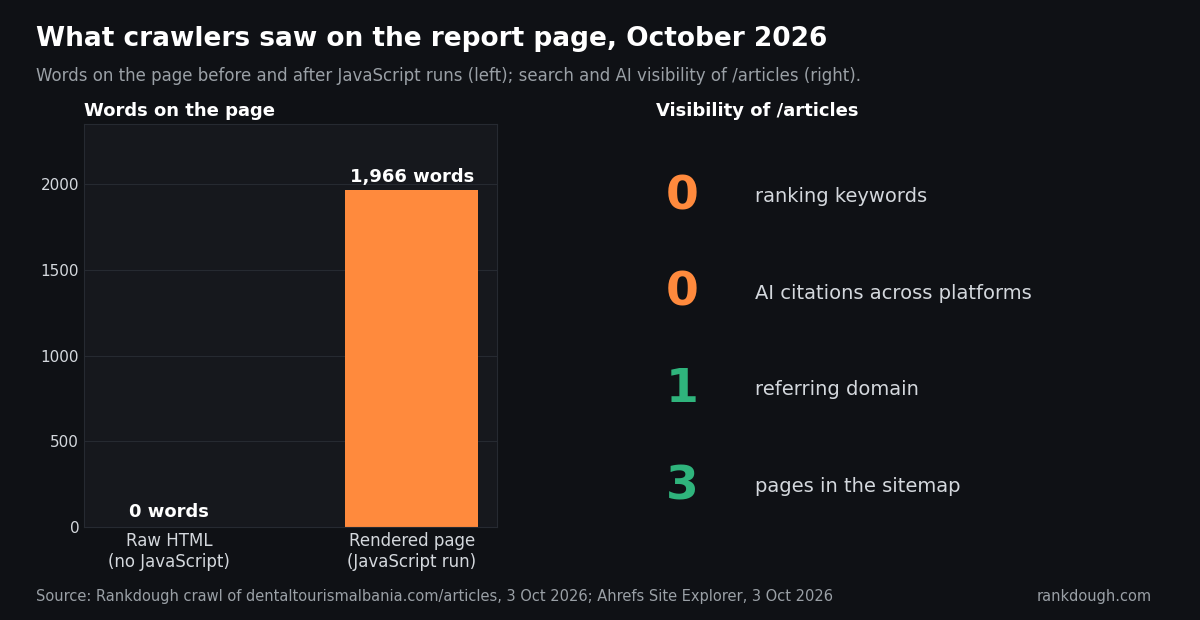
| Check | Result | Effect |
|---|---|---|
| Body text before JavaScript | 0 words | AI crawlers that do not render JavaScript see an empty page |
| Body text after JavaScript | 1,966 words | Google can read it once rendered |
| Canonical target | 1 word on the page | The canonical pointed to a subdomain that renders nothing |
| Ranking keywords for /articles | 0 | No search visibility yet |
| Referring domains to /articles | 1 | The report has not been pitched yet |
- JavaScript-only content: Google renders JavaScript, but its own documentation recommends server-side or pre-rendering because it makes pages faster and more reliable for users and crawlers.
- Canonical tags: a canonical tells Google which URL is the main version. Pointing it at an empty page sends the wrong signal.
- Dates: the page printed the visitor’s current date as the publication date. Google’s guidance is to show a clear, accurate publication date and a last-updated date.
Source: Rankdough crawl of dentaltourismalbania.com/articles and Ahrefs Site Explorer, 3 October 2026; Google Search Central, JavaScript SEO basics, canonical and byline date documentation.
What checklist does Rankdough use before launching a data asset?
Rankdough now runs eight checks before any data asset goes live, so the work that went into the data is not wasted on a page nobody can find.
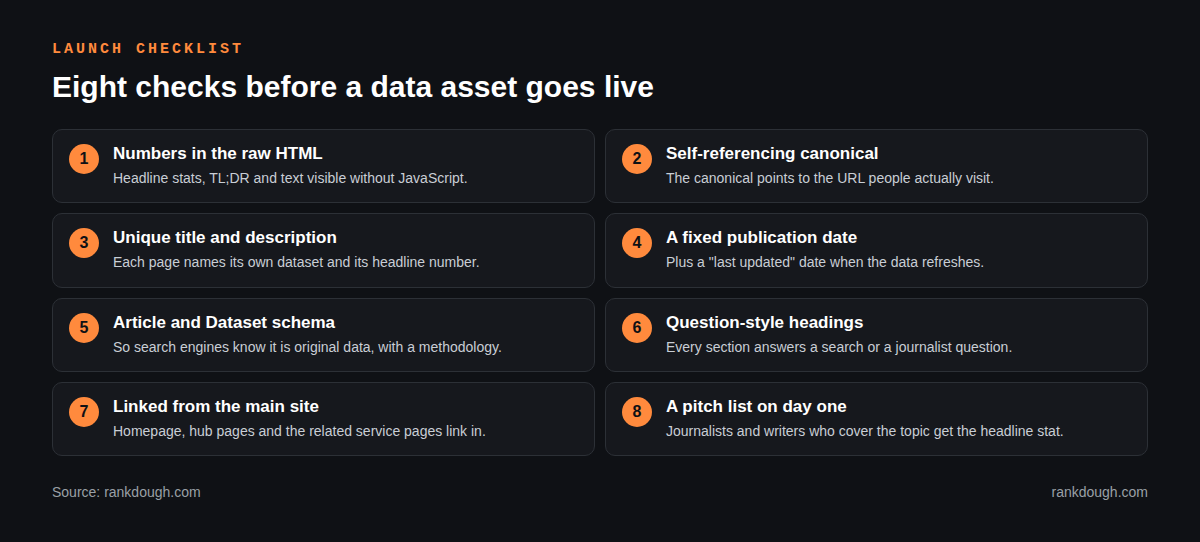
- Numbers in the raw HTML: headline stats and the TL;DR are readable without JavaScript, through server-side rendering or pre-rendering.
- Self-referencing canonical: each page points to its own public URL.
- Unique title and description: each page names its dataset and headline number.
- A fixed publication date: plus a last-updated date when the data refreshes.
- Article and Dataset schema: structured data that describes the dataset, its source and its methodology.
- Question-style headings: each section answers a search or a journalist’s question.
- Linked from the main site: the homepage, hub pages and related service pages link to the report.
- A pitch list on day one: writers who cover the topic get the headline stat and a link.
Source: Rankdough launch checklist; Google Search Central, Dataset structured data.
FAQ
What is a data-led link magnet?
A page built on original numbers that nobody else has, such as an analysis of thousands of reviews. Writers, journalists and AI answers cite it because it is the source, which earns links and mentions a normal blog post does not.
Why use reviews as the data source?
Public reviews are large, current and written in customers’ own words. For Dental Tourism Albania, 10,371 Trustpilot reviews from 280 clinics gave a dataset big enough to compare five countries and five treatments.
How long does a data report take to build?
The Dental Tourism Albania report app was built between 14 April and 1 May 2026: collection, verification, classification and the interactive report. Promotion and technical fixes come after launch.
Why can a data report fail to rank?
Most often because search engines and AI crawlers cannot read it. If the numbers only appear after JavaScript runs, the canonical points elsewhere, or no page links to it, the report stays invisible however good the data is.
Can a data report work as a lead magnet?
Yes, when it answers the decision the buyer is making. A patient choosing between Turkey and Albania gets a comparison they cannot find elsewhere, with links to the treatment pages that sell.
Sources
- Dental Tourism Albania, The State of Dental Tourism 2026
- Google Search Central, Creating helpful, reliable, people-first content
- Google Search Central, Understand JavaScript SEO basics
Rankdough treats every data asset as two projects: the research that makes it worth citing, and the technical work that makes it findable.
