
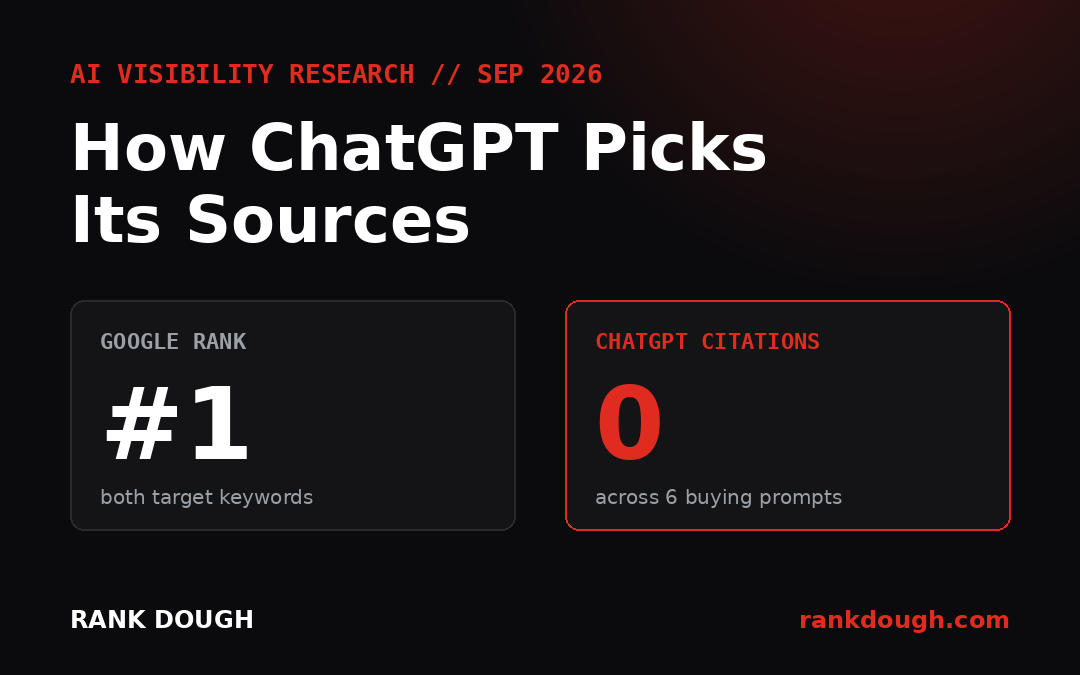
ChatGPT cited 15 pages across the six buying prompts Rank Dough tested in September 2026, and not one of them ranked in Google’s top 10 for the matching keyword. The brand that held the #1 Google position for both target keywords earned zero citations across all six prompts.
I spent three weeks finding out why, across three rounds of testing and two different GPT set-ups (the ChatGPT app and a GPT agent workspace), and the short answer is that ChatGPT cites pages it can lift a complete fact sentence from, not pages that rank.
TL;DR
Across six commercial prompts, ChatGPT’s citations overlapped with Google’s top 10 exactly zero times, and most of the pages it picked shared one trait: a sentence stating turnaround, minimum order, price or production location sat in the opening, a heading or the meta description. ChatGPT answered from cached page extracts and opened zero live pages, so schema, scripts and anything buried below your cart drawer never reached it. The evidence points to fixing the extract first and matching your page wording to the buyer criteria the model appends to its searches, then measuring retrieval and citation as separate outcomes.
How this was researched
The work behind the numbers, so you can judge them for yourself.
EFFORT
Three weeks, three rounds
6 buying prompts run in fresh ChatGPT chats on 1 September 2026, re-run with a GPT agent in a separate workspace on 7 September, and a full interrogation of the search tool on 21 September. 23 pages fetched as raw HTML and scored by hand on 22 attributes.
ORIGINALITY
First-party test data
The prompts, citation logs and page scores are Rank Dough’s own. You won’t find them anywhere else, because nobody else ran this test on this market.
SKILL
Run by an SEO, not a tool
Designed and scored by Roman Sadowski, who has run technical SEO and site migrations since his agency years at iProspect. Google positions from Ahrefs SERP Overview, US, August 2026.
ACCURACY
What it doesn’t prove
One market, 23 pages, observed gaps rather than proven causes. Only 5 of the 18 URLs from the first run reappeared in the 7 September rerun, so treat the patterns as strong signals to test on your own site, not rules.
How did we test which websites ChatGPT cites?
We picked one vertical, custom softball jerseys in the US, where a brand we know ranks #1 in Google for the two head terms. I wrote six buying prompts, ran each in a fresh ChatGPT chat with web search on, and recorded every linked source URL.
Then I fetched every cited page plus every page in Google’s US top 10 for the matching keywords as raw HTML, and scored all 23 pages on 22 attributes: opening content, headings, stated facts, FAQ, schema, speed, robots.txt and more.
Methodology: all citation data comes from ChatGPT runs on 1 September 2026, re-tested with a GPT agent in a separate workspace on 7 September; Google positions come from Ahrefs SERP Overview (US, checked 30 July and 12 August 2026); page attributes come from raw HTML fetches on the same days, which we used as a stand-in for what ChatGPT’s crawler sees. That it doesn’t run JavaScript is our observation from these tests, not something OpenAI documents.
| ChatGPT prompt | Google keyword compared | Brand’s Google position | Brand in ChatGPT’s answer | Other pages ChatGPT cited | Of those, in Google’s top 10 |
|---|---|---|---|---|---|
| Head term custom softball jerseys providers US |
custom softball jerseys | #1 | Not cited | 7 | 0 |
| Niche term custom slowpitch softball jerseys US |
custom slowpitch softball jerseys | #1 | Not cited | 4 | 0 |
| Natural question Where can I order custom slowpitch softball jerseys for my team in the US? |
custom slowpitch softball jerseys | #1 | Not cited | 5 | 0 |
| Best-of Best companies for custom softball jerseys in the United States |
custom softball jerseys | #1 | Not cited | 6 | 0 |
| Audience-specific Who makes custom sublimated softball uniforms for adult slowpitch teams? |
custom slowpitch softball jerseys | #1 | Not cited | 6 | 0 |
| Attribute-led custom team softball jerseys with fast turnaround in the USA |
custom softball jerseys | #1 | Not cited | 5 | 0 |
| All six prompts | both head terms | #1 | Not cited | 33 citations, 15 unique pages | 0 |
Source: Rank Dough citation test log, ChatGPT app, 1 September 2026; Ahrefs SERP Overview, US, “custom softball jerseys” checked 12 August 2026 and “custom slowpitch softball jerseys” checked 30 July 2026. Prompts are not Google keywords, so each was compared with the closest of the two head terms.
The brand at #1 in Google for both head terms, custom softball jerseys and custom slowpitch softball jerseys, was cited on none of the six prompts. ChatGPT cited 15 other pages instead, 33 times in total because several were cited on more than one prompt, and none of them ranked in Google’s top 10 for those terms. Google’s own AI Overview for custom softball jerseys didn’t cite the brand either: it listed 12 other URLs.
Why does ranking #1 in Google earn zero ChatGPT citations?
Because ChatGPT is not reading Google. It rewrites your prompt into its own search queries, pulls candidates from its own index, and picks sources from the text extracts attached to those results.
Our reading is that Google rank never enters that pipeline. In the 7 September rerun, the #1 Google brand didn’t appear in any of the six retrieval outputs, so it lost before its page was ever judged. That rerun used a GPT agent in a separate workspace, not the ChatGPT app, so treat it as a strong pointer rather than proof.
The page had a second problem as well. The #1 Google result was a shopping grid whose first 1,300 lines of its raw HTML were a cart drawer, navigation and product counts.
The first commercial fact on the page, a 3 to 4 week lead time, sat at line 1,303 of 1,754. A competing page that got cited stated its lead time at line 45.
Position inside ChatGPT’s own result list did not decide selection either. In a follow-up audit the model cited results sitting at positions 12 and 14 and skipped another competitor holding position 1 in ChatGPT’s own result list with three URLs. The #1 Google brand wasn’t in that list at all.
My working model after three rounds, labelled as a hypothesis, is a four-stage funnel: the brand has to be recognised, the page has to match the model’s rewritten queries, the URL has to enter the result set, and the extract has to win selection. In this test, most pages failed at stage two or four, not stage three.
Source: Rank Dough citation test and GPT workspace audit, September 2026; line positions from raw HTML fetches, 21 September 2026.
What did cited pages have that ranking pages didn’t?
We scored the 15 cited pages against 8 pages that ranked in Google’s top 10 but were never cited. Six attributes separated the groups.
Word count did not: cited pages averaged 1,726 words against 2,143 for the ranking pages, and the two shortest cited pages ran 137 and 213 words. Price being shown, Product schema and robots.txt access did not separate the groups either, because every page in both groups already allowed the AI crawlers.

| Attribute | Cited pages (n=15) | Ranking, not cited (of 8 pages) |
|---|---|---|
| Named leagues or brands on the page | 87% | 0 of 8 |
| FAQ section | 80% | 2 of 8 |
| Offer stated in the first 50 words | 73% | 1 of 8 |
| Meta description carrying concrete numbers | 67% | 1 of 8 |
| URL slug matching the query wording | 60% | 2 of 8 |
| Minimum order stated | 47% | 1 of 8 |
Source: Rank Dough page scoring workbook, 23 pages, September 2026. These are observed gaps in one vertical, not proven causes.
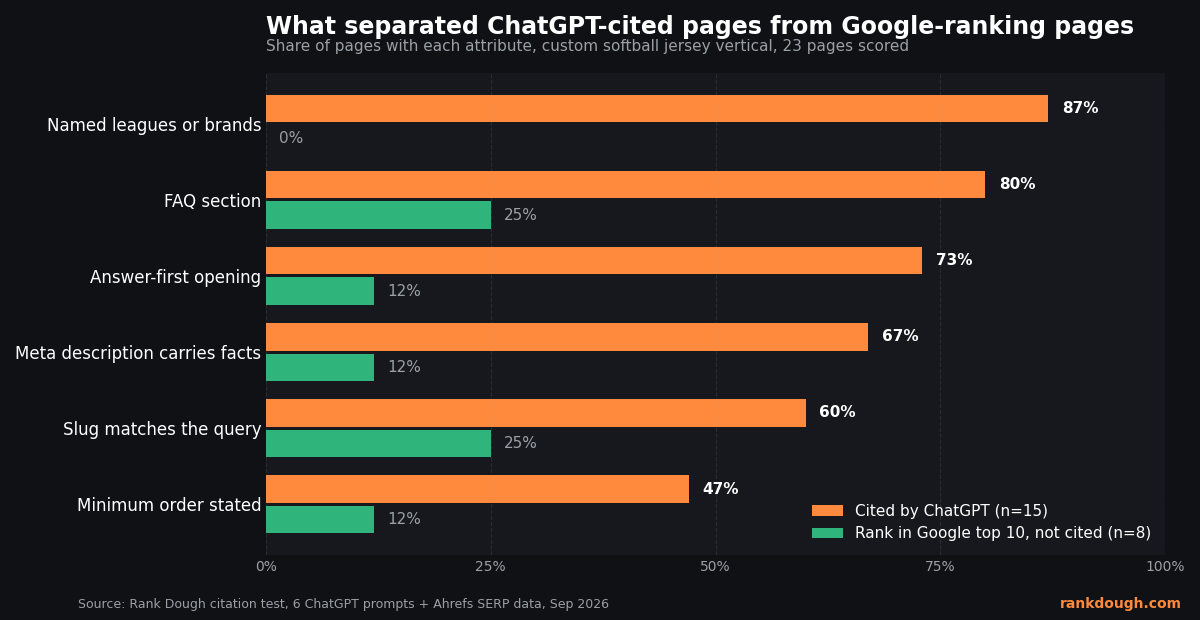
The pattern behind the numbers is extraction. ChatGPT’s answer bullets repeated fact sentences from the cited pages near word for word: a 21-day production claim from one page’s opening, a 10-player minimum and a $109.97 price from another’s meta description, a 3 to 5 week turnaround from a single sentence on a 137-word page.
Pages that gave the model a liftable sentence got quoted. Pages that made it hunt got skipped, and when the model could not find a number it either wrote “request a quote” or, twice in our logs, invented a turnaround figure the page never stated.
What does ChatGPT actually read when it cites a page?
A cached text extract, not your live page. Across two audited runs ChatGPT cited 5 of 17 and 6 of 16 returned results while opening zero pages.
Each result carried a stitched extract of the page: headline, intro copy, bullets, prices and FAQ text, with per-page crawl ages running from two weeks to a year. Three things follow from that.
- Your structured data is invisible at the moment of citation. The extract carried no JSON-LD, no schema.org markup and no meta tags in any audited run. Keep schema for Google; stop selling it as a ChatGPT citation factor.
- Bot walls block page opens, not citations. One cited page in our test sat behind a password wall and another behind a bot challenge, and both kept earning citations from stale extracts. The same lag works against you: a fixed page stays invisible until the crawler returns, so plan in weeks.
- Template order looks like a citation factor, though we haven’t tested it directly. Whatever your theme prints first in the HTML is what fills the extract. A cart drawer and a mega menu in front of your content push the facts out of the window the model reads.
Source: GPT workspace audit ledger, 7 September 2026; web.run interrogation, 21 September 2026.
How do fan-out queries decide which pages compete?
In neither audited run did ChatGPT search the words we typed. Both times it rewrote the prompt and appended buyer decision criteria: minimum order, turnaround, pricing, youth sizing.
Those appended terms are retrieval keys. A page that states its minimum and turnaround in plain text matches the queries the model actually sends; a page that keeps those facts in a PDF or behind a quote form competes for nothing.
The rewrites also seeded brand names the model already knew from training into the searches, which means well-mentioned brands enter the candidate pool by name while unknown brands fight for the generic slots. Our reading, not yet measured: that makes third-party mentions a retrieval problem, not a vanity metric.
You can see this layer first-party and free. Bing Webmaster Tools added an AI Performance report in February 2026 and expanded it in June 2026 with intents, topics and citation share.
Its grounding queries show the reformulated searches the AI ran before citing or skipping you on the Microsoft surface. Verify your site, pull 30 days of grounding queries, and you have a proxy for the searches AI systems run. It comes from Microsoft’s AI, not ChatGPT, so treat it as a guide rather than a mirror.
Source: Rank Dough audit logs, September 2026; Bing Webmaster blog, February and June 2026.
What should you change on your pages first?
- Write one sentence per key page in this shape: brand, product, audience, turnaround, minimum, price, where it’s made. Place it in the first 50 words under the H1, repeat the numbers in the meta description.
- Turn headings into claims. “Turnaround is 3 to 4 weeks” beats “Why choose us” because headings survive extraction and vague ones carry nothing.
- Build one page per intent wording. In our data the competitor brands that did get cited came in on different prompts through different pages, jerseys against uniforms, adult against youth, standard against rush. Individual URLs churned between runs while brands persisted through intent-matched sister pages.
- Keep key facts in plain text as well as inside accordions. One model read accordion FAQs fine; another missed a minimum order stated inside one. Plain text is the safe version.
- Add an FAQ section that answers the buying questions with numbers, and keep your support pages crawlable. In one run the #1 citation for a fast-turnaround prompt was a retailer’s delivery help page whose headings were the delivery speeds.
- Check what your template prints before the content, and check your per-page crawl ages before judging any fix.
What stayed unstable across our tests?
Three things refused to settle, and I’d rather tell you than sell you certainty. Listicles got cited in one round, where a competitor’s dated comparison post became the source for a third brand’s recommendation, and got skipped in another round a week later.
Reddit threads entered 12 of 12 commercial retrieval pools we audited but rarely won selection, so pool presence and citation are different outcomes. And only 5 of the 18 URLs from the first run reappeared in the 7 September rerun, which means a single test proves nothing and any agency promising a specific citation is guessing.
Run your prompts across several days, track visible retrieval, citation and accuracy as three separate numbers, and judge changes against that baseline.
Source: Rank Dough citation logs, 1 and 7 September 2026; retrieval pool audits, September 2026.
Limits of this test. The attribute table comes from a single run on 1 September. We scored the HTML as it was on the day, while ChatGPT read extracts up to a year old. And we didn’t change a page and re-test it, so everything here is correlation, not proof of cause.
FAQ
Does ranking in Google help you get cited by ChatGPT?
Not directly. In our September 2026 test, ChatGPT’s citations overlapped with Google’s top 10 zero times across six prompts, and the #1 Google result earned no citations. Google rank still matters for Google’s own results, but ChatGPT selects from its own index and its own extracts.
Does schema markup help ChatGPT cite your page?
We found no evidence it does. The text extracts ChatGPT cites from carried no JSON-LD or meta markup in any audited run, and schema presence did not separate cited from uncited pages in our scoring. Keep schema for Google rich results; treat it as neutral for ChatGPT citations.
What did the cited pages have in common?
Put a complete fact sentence in the first 50 words of your key page: product, audience, turnaround, minimum, price, origin. Repeat the numbers in the meta description. Every verbatim quote we logged in ChatGPT’s answers came from the opening, a heading or the meta description. Treat the uplift as a hypothesis to measure, not a guarantee.
How long before a page change shows up in ChatGPT?
Expect weeks, not days. ChatGPT answered from cached extracts with crawl ages from two weeks to a year in our audits, and kept citing one page after it went behind a password wall. Check your server logs for OAI-SearchBot visits to see your own re-crawl cadence.
How do you measure ChatGPT citations properly?
Track three numbers separately: how often your URL appears in the visible result set, how often it gets cited, and whether the claim in the answer is actually on your page. Only 5 of 18 cited URLs repeated between our runs a week apart, so run each prompt several times across several days before judging any change. Bing Webmaster Tools’ AI Performance report gives you the Microsoft side first-party.
Sources
- Rank Dough citation test workbook: 6 ChatGPT prompts, 23 pages scored, 1 September 2026; second-model rerun ledger, 7 September 2026; web.run interrogation, 21 September 2026
- OpenAI, Overview of OpenAI Crawlers: developers.openai.com/api/docs/bots
- Microsoft Bing, Introducing AI Performance in Bing Webmaster Tools, February 2026: blogs.bing.com
