
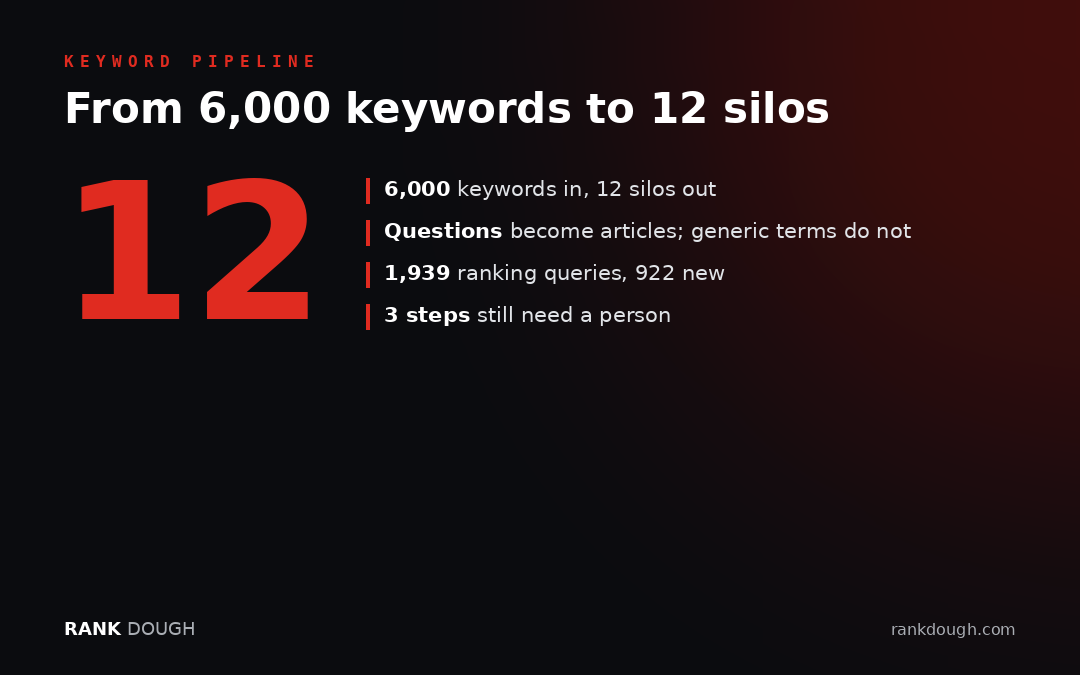
At Rankdough a keyword export becomes a content plan in five steps: expand the seeds, split questions from generic terms, cluster the questions into at most 12 silos, attach volume and a research prompt to every idea, and queue them in volume order; on trackbarn.com that plan produced 455 pages ranking for 1,939 queries, 922 of which had no impressions a year earlier.
TL;DR
A keyword export is not a content plan: my system turns up to 6,000 keywords into one in five steps, clustering questions into at most 12 silos. The rule that does most of the work is the split, where questions become articles and generic terms become collection or landing pages. On trackbarn.com the plan produced 455 pages that rank for 1,939 queries, 922 of which had zero impressions a year earlier.
How this was researched
The work behind the numbers, so you can judge them for yourself.
EFFORT
Built over five months
The keyword pipeline was built between January and June 2026, with clustering runs logged on 9 May and 3 June, then applied to 455 pages on a client store.
ORIGINALITY
Our own pipeline
Every step comes from our content system build record, with the dates.
SKILL
Run by an SEO, not a tool
Designed by Roman Sadowski, who still checks every silo by hand before anything is briefed.
ACCURACY
What it doesn’t prove
One site. Clustering failed at 1,600 keywords and needed a human fix, and some pages were built for searchers who will never buy.
Step one: how do you build the keyword universe?
| Step | Input | Output | Rule and date |
|---|---|---|---|
| 1 Universe | Seeds, questionnaire, up to 3 exports | Expanded keyword universe | Modifiers added by hand, 12 Mar 2026 |
| 2 Split | Universe | Questions vs generic terms | Articles from questions only, 6 Mar 2026 |
| 3 Cluster | Questions | Max 12 silos | Batching with cross-batch pass, 9 May 2026 |
| 4 Attach | Silos | Volume, research prompt, value promise per idea | Value promise as reader outcome, 7 Apr 2026 |
| 5 Queue and prune | Ideas by volume | Pages, then monthly pruning | Clicks, country, duplicate pairs |
Table 1. The five steps from export to plan, with the rule that governs each. Rankdough content system build record.
Inputs are a questionnaire about the business, the client’s own site, up to three keyword exports from Ahrefs or Search Console, and seed terms. The system expands seeds with modifiers into a Semantic Keyword Universe, grouped by theme, with a site scan across up to three domains and a country setting.
The first version of this missed obvious modifiers. For a toy retailer it had no age terms; I added “for one-year-old”, “for two-year-old” and so on by hand on 12 March 2026.
Source: Rankdough content system build record, Semantic Keyword Universe, 12 March 2026
The lesson stuck: the universe is a draft. The person who knows the business adds the modifiers the tool cannot infer, and that happens before any clustering, because a modifier missing at this stage is a silo missing at the end.
Step two: why do questions become articles and generic terms never do?
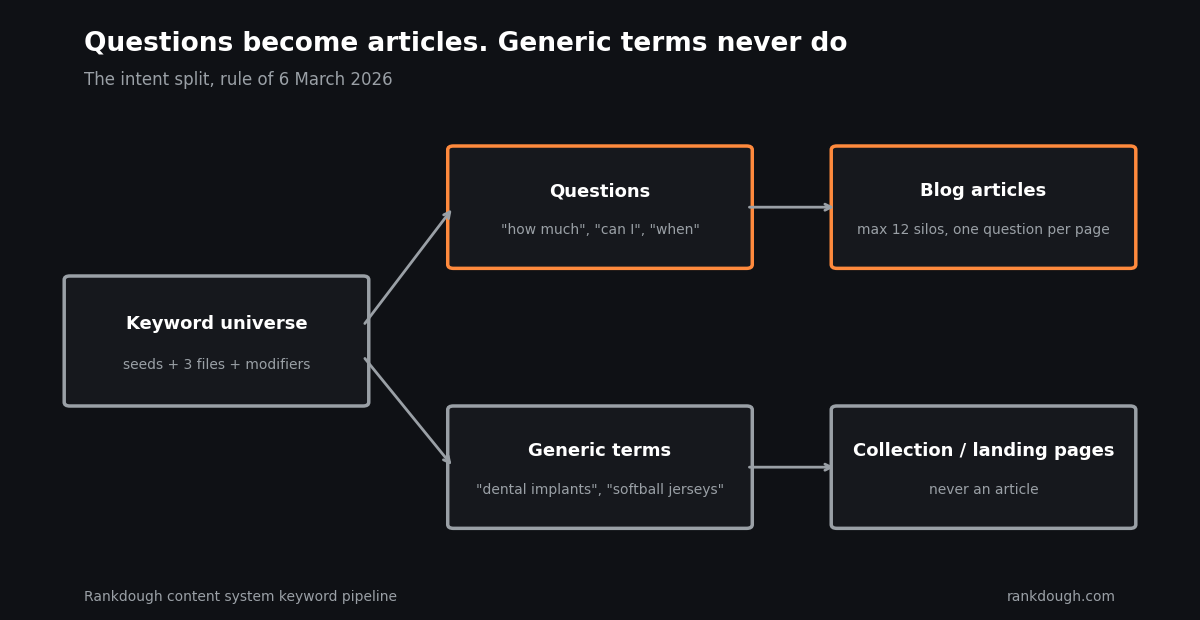
This rule went in on 6 March 2026 and it is the one I would keep if I could keep only one.
A question (“how much do custom softball jerseys cost”, “can I eat chocolate after tooth extraction”) has a single answer and a single reader at a single point in a decision. It makes an article.
A generic term (“softball jerseys”, “dental implants”) has no answer. A page built from it comes out as a definition followed by a list, which is the most interchangeable page on the internet and the first to lose to an AI summary.
Source: Rankdough content system build record, 6 March 2026; Google Search Central, Creating helpful, reliable, people-first content
So the split is hard-coded. Questions go to the blog ideas list.
Generic terms go to the landing-page ideas list, where they become collection pages, category pages or service pages with product grids and prices, not prose. The system does not generate an article from a generic term, and when it was asked to, the result was the “complete guide” that ranks for nothing because it answers nothing first.
Step three: how do you cluster into twelve silos?
Questions are clustered into silos, capped at 12 for a site and at 3 when adding to an existing plan. The cap is deliberate: more than 12 silos and the internal linking has no shape, and a site with no shape has no topical authority to pass around.
Clustering has to be semantic, not lexical. “How much are dental implants UK” and “dental implant cost” are one page.
“Can I eat chocolate after tooth extraction” and “when can I eat chocolate after tooth extraction” are one page. A reader knows this instantly; software has to be told, and at scale it still gets it wrong.
On 3 June 2026 a 1,600-keyword run put baseball terms in a dental implant silo. Lists above 5,000 keywords failed until batching with a cross-batch pass was added on 9 May, and remained unreliable after.
Source: Rankdough content system build record, clustering runs 9 May and 3 June 2026
So the human check sits here. Silos are reviewed before briefing: a keyword from the source file that is missing from every silo is a bug (I caught “bat” missing from a sports plan this way), and any silo a reader would merge gets merged.
Step four: what does every idea carry before it is written?
Each blog idea carries the search volume of the keywords it covers, tags, the client, and three generated artefacts:
- A deep-research prompt specific to the question, which produces the research brief that becomes the article’s only fact source
- Target keywords drawn from the silo, so the article is briefed against what people search rather than what sounds good
- A value promise: what the reader will be able to evaluate after reading, aligned to the target keyword, verified point by point after generation
Ideas can be bookmarked, moved to the queue, or sent to the generator without retyping. The volume total per idea decides order.
The point of attaching the prompt at idea stage is that the brief is written for the question, not for the topic. A brief on “dental implants” produces a commodity article; a brief on “how much do implants cost in Albania compared with the UK” produces one with numbers in the first sentence.
Step five: what happens after the plan meets the data?
Ideas are written in volume order through the generator, in programmatic mode for short question pages and proprietary mode for long ones. Then the plan meets the data.
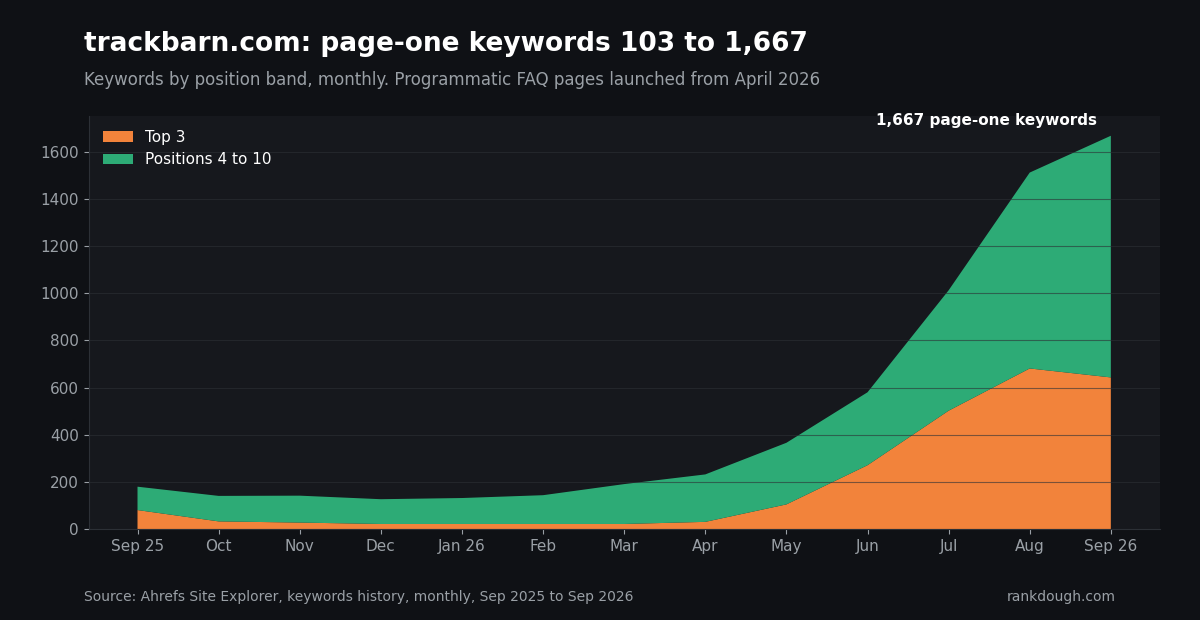
trackbarn.com, Google Search Console, 28 days to 22 September 2026: 1,939 queries with impressions, 922 of which had zero impressions in the same period a year earlier. Page-one keywords in Ahrefs went from 103 in September 2025 to 1,667 in September 2026. The plan produced the coverage it was built for.
These figures were compiled from the Google Search Console Pages, Queries and Countries reports for the 28 days to 22 September 2026, compared against the same period in 2025.
It also produced two things the plan could not see.
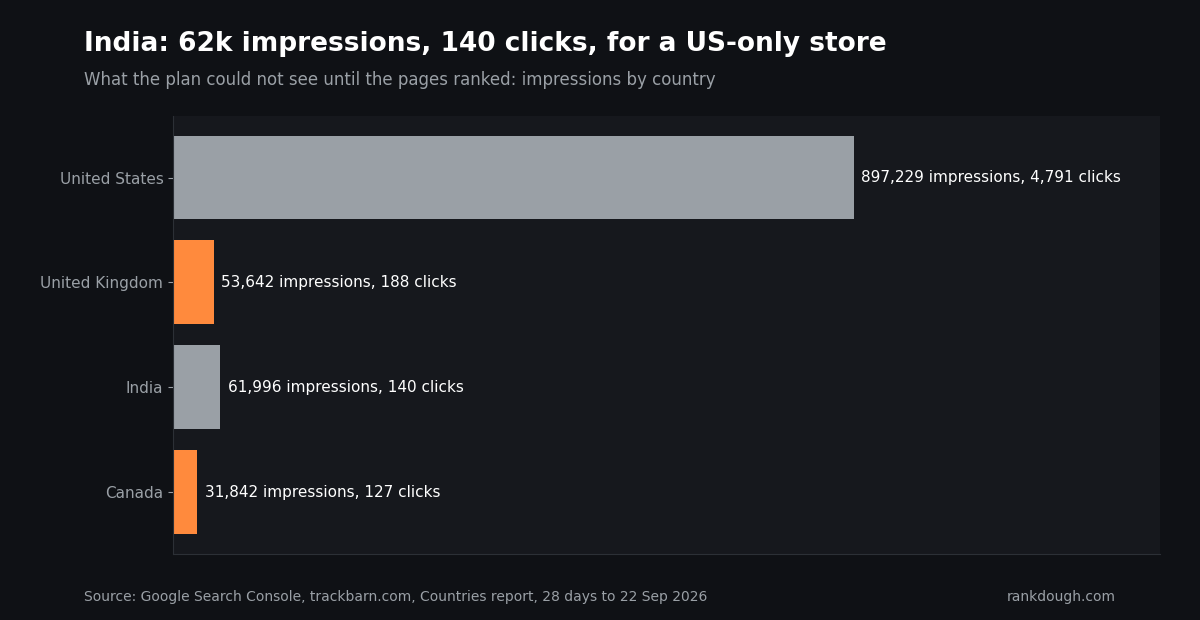
61,996 impressions and 140 clicks from India, for a store that ships in the United States, because English question pages rank wherever English is searched. And 98 of 455 pages with zero clicks, because volume at planning stage is not the same as clicks after ranking.
Both are pruning decisions, taken monthly, from the data. Neither is a reason to have planned less.
Where does the method still need a person?
- Modifiers at universe stage. The tool expands what it is given; it does not know the age bands, sizes or regions that define the client’s market.
- Silo review at scale. Above a few thousand keywords, clustering needs a reader to merge and split. Treat the cap of 12 as a forcing function, not a guarantee.
- Buyer distance. Volume orders the queue; it does not say whether the searcher is a customer. That score is applied by hand before the brief, and it is the difference between pages that rank and pages that pay.
What should you do with your own keyword export?
- Read the client’s site first: homepage, pricing, policies, service pages. Every page you plan must land the reader one click from something sold.
- Split the export into questions and generic terms. Articles from the first list only.
- Cluster the questions into no more than 12 groups, merging anything a reader would treat as one question.
- Attach volume, a research prompt and a one-line value promise to each idea.
- Write in volume order, then prune monthly on clicks, country and duplicate pairs. That is the sequence Rankdough runs for every client plan.
Related: the same method with buyer distance in its right place, and the TrackBarn walk-through, in content gap analysis and the worked example.
FAQ
Why never write an article from a generic term?
A generic term has no single answer, so the article becomes a definition and a list. That page is interchangeable with every competitor’s and is the first to be replaced by an AI summary. Generic terms become collection or service pages instead.
Why cap silos at twelve?
Internal linking needs a shape to pass authority through. Beyond twelve silos the links spread too thin, and the plan becomes a list of pages rather than a structure.
What is in a research prompt?
The specific question, the target keywords from its silo, the reader stage, and instructions to return sourced figures with URLs. The resulting brief is the only fact source the article may use.
How many of the 455 TrackBarn pages were worth writing?
Measured by clicks, 357 earn at least one click a month and 121 earn ten or more. The 98 with none are being pruned. Measured by buyer distance, the pages scored 3 (never a customer) would not be written today; that count is being finalised and will be published.
Does clustering work at 10,000 keywords?
Not reliably in my system as of June 2026. Batching helps; a human review of the silos is still required above a few thousand terms.
Sources
- Google Search Console, trackbarn.com, Queries, Pages and Countries reports, 28 days to 22 September 2026 versus same period 2025
- Google Search Central, Creating helpful, reliable, people-first content
- Ahrefs, Keyword cannibalization
