
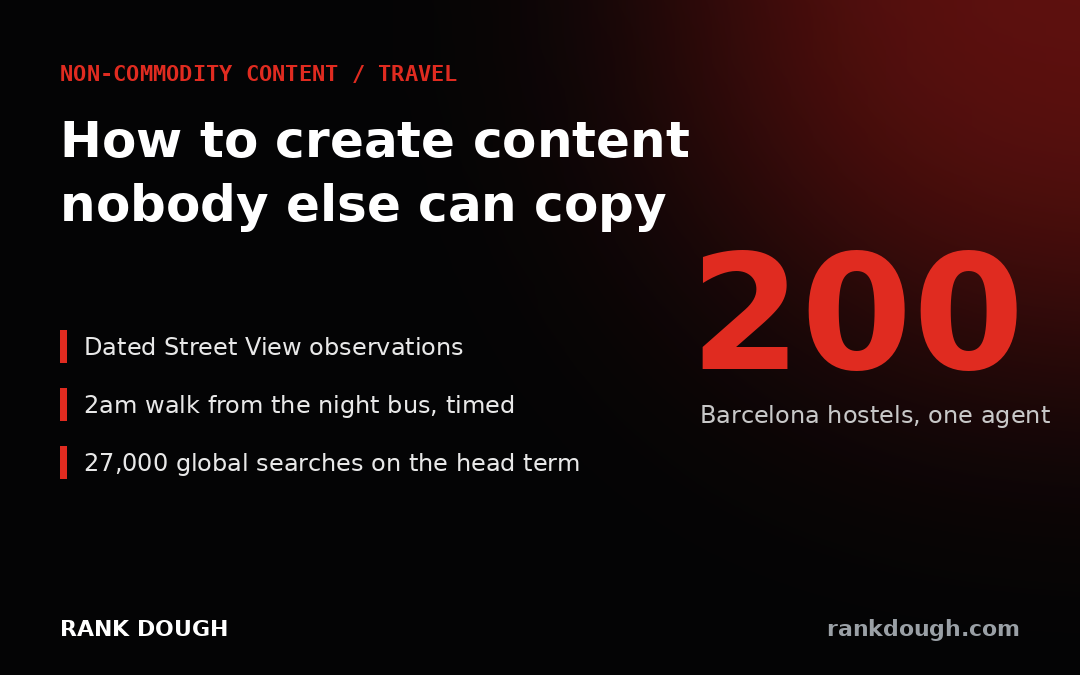
Rankdough creates non-commodity content by building a data source first and writing second. In this travel example, an agent visits 200 Barcelona hostels through Google Maps, logs six dated observations per property, and that log feeds pages for a query cluster whose head term, “best hostels in Barcelona”, gets 27,000 global searches a month at keyword difficulty 0 (Ahrefs, 4 October 2026).
No competitor holds the same numbers, so Google and AI assistants have a reason to pick our page over the other ten.
TL;DR
Commodity content is anything a writer or a model can rebuild from the pages already ranking, and 54% of 220+ sites using AI content tools lost 30% or more of their peak traffic producing it. Non-commodity content starts from an input only you hold: proprietary data, direct experience, access, or a defended position. Rankdough’s Barcelona agent shows the cheapest route to the first: turn a public source into a dated, checked dataset, then write the pages travellers and AI assistants ask for.
How this was researched
The work behind the numbers, so you can judge them for yourself.
EFFORT
Keyword data and a costed build
Ahrefs keyword data for Barcelona hostel and solo-travel searches pulled on 4 October 2026, and the data-collection agent costed the same day.
ORIGINALITY
A worked travel example
How to turn a public source into a dated dataset of your own, using one city and one type of business.
SKILL
Run by an SEO, not a tool
Written by Roman Sadowski, who has worked in travel search and builds data tools for clients.
ACCURACY
What’s illustrative
The log example is marked illustrative, the build cost is an estimate, and the 54% traffic-loss figure is Lily Ray’s published analysis, not our data.
What is non-commodity content?
Non-commodity content is a page whose core input a competitor or a language model can’t reproduce. If you could write the page from the top ten results, it’s commodity, however long or well edited it is.
You get a non-commodity input from one of four places:
- Proprietary data. Orders, outcomes, prices, response times, observations you logged yourself.
- Direct experience. You did the thing, and you have photos, numbers and the mistakes to show it.
- Access. Interviews, expert quotes, a community you run.
- A defended position. A contrarian view with evidence behind it and a name on it.
Google calls the extra value “information gain”. Ethan Smith of Graphite describes the method as converge, then diverge: cover what competitors cover, then add something they don’t have (Maven). Most content teams stop after converging.
Why does commodity content stop working?
Commodity content loses traffic once Google’s quality systems re-evaluate it, and AI assistants have no reason to cite one copy over another. Lily Ray tracked 220+ sites that were public customers of AI content tools and measured each site’s drop from its peak organic traffic.
| Drop from peak organic traffic | Share of the 220+ sites (cumulative) |
|---|---|
| 30% or more | 54% |
| 50% or more | 39% |
| 75% or more | 22% |
Source: Lily Ray, published May 2026, Ahrefs data checked against SISTRIX (Search Engine Journal).
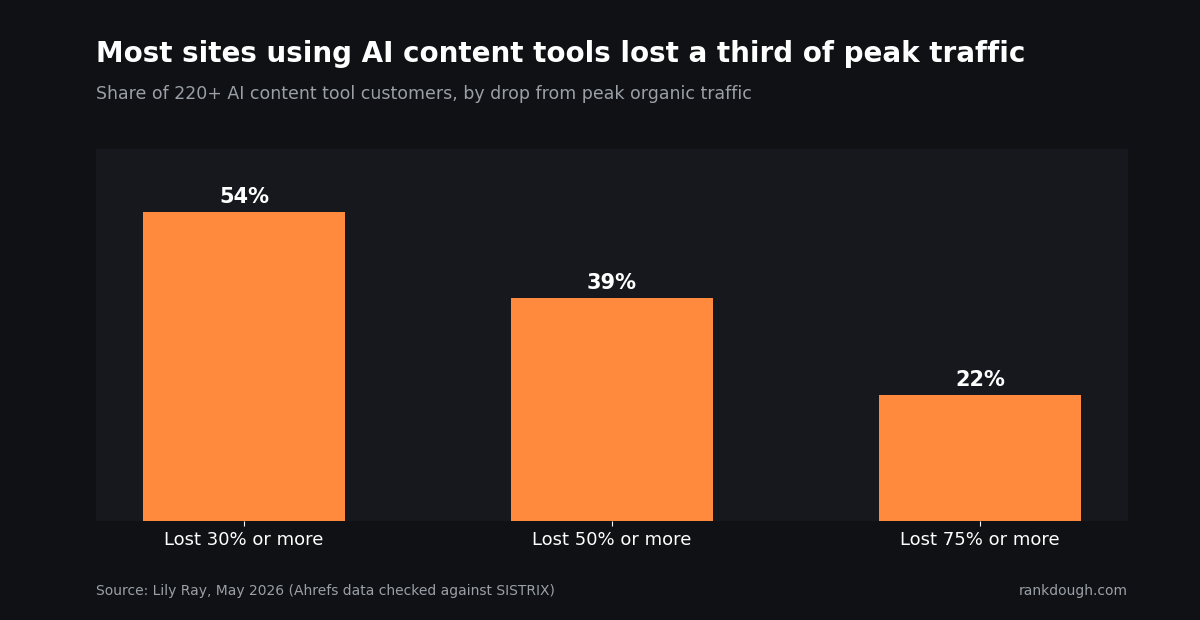
Method: Lily Ray identified the sites from public customer lists of AI content platforms and compared each site’s organic traffic with its peak in Ahrefs, checked against SISTRIX.
AI writing the words didn’t sink those sites. Volume did: thousands of pages carrying nothing the web didn’t already have, at a scale Google’s scaled-content systems notice.
How do you find a data source nobody else has?
Start with the question your audience asks that no ranking page answers with a number. Then find a source you can turn into that number at a cost competitors won’t pay.
For solo travellers in Barcelona, the unanswered question is concrete: what does the walk from the night bus to my hostel look like at 2am? Every safety guide repeats the same city-wide advice. None measures the last 400 metres.
Three tests decide whether a source is worth building:
- It answers a real question with a number. Minutes, counts, shares, dates.
- It costs effort to collect. If a competitor can copy it in an afternoon, it’s commodity next quarter.
- It gets better with time. A dataset you refresh builds a history that nobody can rebuild later.
Google Maps passes all three. The imagery and routing are public, but nobody has scored 200 hostel approaches against a fixed checklist, dated every image and checked a sample by hand.
How did Rankdough build the Barcelona agent?
Rankdough built an observation agent with a traveller’s profile: someone arriving alone, late, with a bag. The profile decides the checklist, and the agent runs the same checklist at every property:
- Time the walk from the nearest night-bus stop and metro entrance at a 02:00 departure.
- Classify the last stretch of street: main street, side street or passage.
- Look for street lamps and a 24-hour reception sign.
- Check whether the door is visible from the corner.
- Record the capture date of every image and flag anything it couldn’t see.
Change the profile and the checklist changes with it. A wheelchair user’s agent counts steps and looks for ramps; a family’s agent checks lift signage and pushchair access. The pipeline stays the same.
What does the dataset look like?
Each visit becomes rows in the agent’s log, and the log is the only thing the agent remembers. The table below is an illustrative example of the format; the Barcelona pilot hasn’t collected real observations yet.
| Property | Approach | Lighting | 24h desk | Night bus 02:00 (min) | Metro (min) | Image | Human check |
|---|---|---|---|---|---|---|---|
| Example Hostel A, Gràcia | Main street | Yes | Yes | 6 | 4 | 2025-03 | Yes |
| Example Hostel B, El Raval | Passage (<3 m) | Unclear | No | 11 | 3 | 2024-11 | No |
| Example Hotel C, Eixample | Main street | Yes | Unclear | 5 | 3 | 2025-06 | Flagged |
| Example Hostel D, Barri Gòtic | Side street | Yes | Yes | 7 | 2 | 2025-01 | Yes |
Source: illustrative example of the Walk the Map log format, Rankdough, October 2026.
Agent method: the agent scores Street View imagery against the checklist in two independent passes, times walks with the Routes API, and a person checks every disagreement plus a random sample of 20 properties.
The agent never edits a past row. When it goes back next quarter, it writes new ones, so the log turns into a history: a hostel that gained a reception sign, a street with new lighting, a property that closed. That history is the part competitors can’t buy.
Can readers ask the agent directly?
Yes. The agent answers questions from its log, so readers get a conversation that stays inside the evidence. An illustrative exchange:
You: What’s the walk like from the night bus to Example Hostel B?
Agent: Eleven minutes from the nearest night-bus stop at 02:00. The last stretch is a passage under three metres wide. I couldn’t make out street lamps in the imagery, and I saw no 24-hour reception sign. The images are from November 2024, and no person has checked this one yet.
You: Would you feel safe walking it?
Agent: I can’t tell you that. I haven’t walked it at night, and daytime images don’t show how busy or lit a street is at 2am. If you’re arriving late, the hostel I visited in Gràcia has a main-street approach, a reception sign and a six-minute walk from the bus.
Each sentence the agent says points to a row in the log. That traceability is what you’d want a journalist, a forum moderator or an AI assistant to see before they cite you.
How does the agent collect each observation?
The agent works through one visit in six steps, and every step writes to the same log:
- Find the property address with the Places API.
- Look at the street with the Street View Static API: three headings at the entrance and one from the nearest corner, each with its capture date.
- Score the images against the checklist in two separate vision passes.
- Send disagreements to a person; agreements go straight into the log.
- Time the walk from the nearest night-bus stop and metro with the Routes API at a 02:00 departure.
- Store image date, model version and checker on every row. The agent and the pages read only from those rows.
Where is the line between original data and fabricated experience?
The agent knows what it observed, not how a place feels. That boundary is what makes its answers worth citing.
It can tell you:
- What the approach and the door looked like, and the date of the image.
- Whether street lamps and a reception sign were visible in that image.
- Walking times the routing engine returned, and when it asked.
- Where it couldn’t see anything, which is a finding in itself.
- Whether a person has checked the observation.
It won’t tell you:
- Whether a street is safe, busy or well lit at night. Daytime imagery can’t show that, and it says so.
- Current conditions. Street View imagery can be two to four years old, so every answer carries the date.
- Anything phrased as lived experience. It says “in imagery from March 2025”, never “when I walked there”.
An agent that invents memories produces what any model can produce, so it has no scarcity, and presenting it as testimony runs against Google’s guidance on first-hand, people-first content. An agent that records dated observations produces something only its owner holds.
Which search terms does the data target?
Rankdough doesn’t publish the log as a log. The data feeds pages built for the queries travellers type, and the numbers decide which pages earn the build.
| Query | US monthly searches | Global monthly searches | Keyword difficulty |
|---|---|---|---|
| best hostels in barcelona | 7,700 | 27,000 | 0 |
| hostels barcelona | 700 | 4,100 | n/a |
| is barcelona safe for solo female travellers | 100 | 350 | 0 |
| solo travel barcelona | 70 | 200 | 0 |
| barcelona solo travel | 60 | 200 | 0 |
| solo trip to barcelona | 40 | 100 | 0 |
| accessible hotels barcelona | 30 | 70 | 0 |
Source: Ahrefs Keywords Explorer, pulled 4 October 2026. Keyword difficulty not reported for “hostels barcelona”.
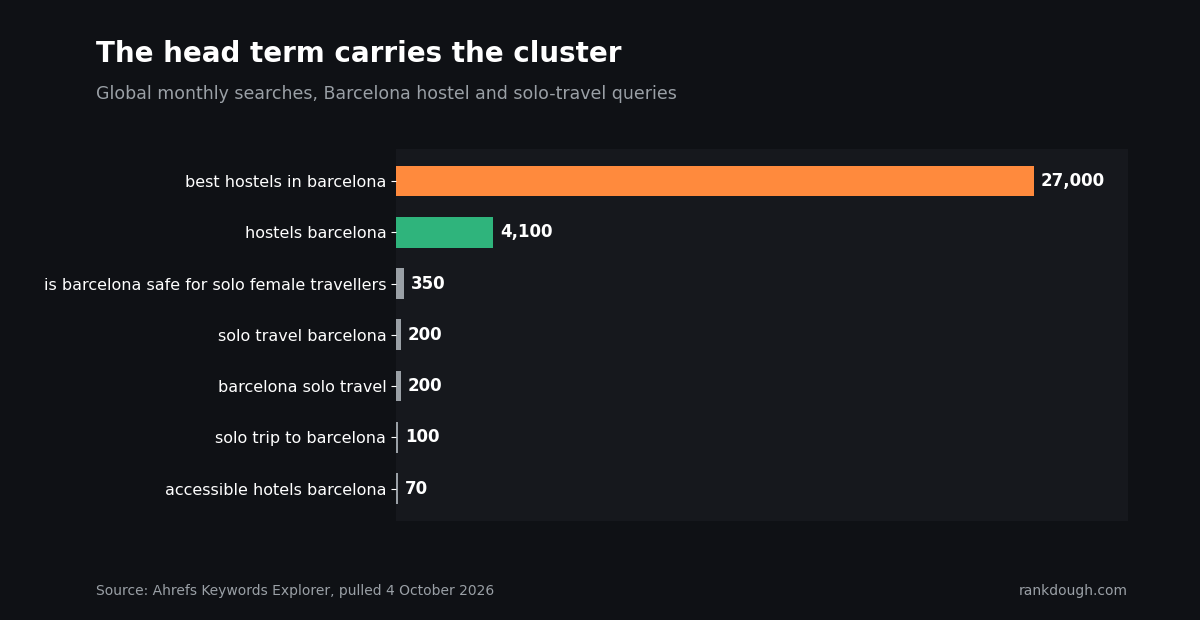
The table points to three pages, each with a different job:
- The head term. “Best hostels in Barcelona” is a list page. A list backed by 200 measured night walks is the only one on that results page with information gain.
- The parent topic. “Is Barcelona safe for solo female travellers?” gets answered with district-level numbers from the log instead of the usual Las Ramblas warning.
- AI citations. Long questions such as “hostel in Gràcia on a main street near the night bus” go to ChatGPT and Perplexity, where only 12% of cited sources sit in Google’s top 10 (Ahrefs). AI questions average about 23 words against 6 on Google, according to Ethan Smith (Maven).
We checked accessibility terms too and dropped them. At 30 US searches a month for the top query, the cluster can’t justify its own page.
Mentions do the rest. Ahrefs studied 75,000 brands and measured how three signals correlate with AI Overview visibility.
| Signal | Correlation with AI Overview visibility |
|---|---|
| YouTube mentions | 0.737 |
| Branded web mentions | 0.664 |
| Backlinks | 0.218 |
Source: Ahrefs study reported by Search Engine Land.
A dated city report with a published method gives travel forums, hostel associations and YouTube creators something specific to mention. Rankdough treats each quarterly re-run as a new edition and a new reason to cite; we’ll report whether mentions compound once two editions are live.
What does a data source like this cost to build?
One city costs less than a day of consulting. The figures below are estimates until the pilot is billed.
| Step | Volume | Estimated cost |
|---|---|---|
| Places and Street View calls | 200 properties | under €20 |
| Two vision passes | about 800 images | under €10 |
| Routes API walks | 400 walks | under €5 |
| Human check | 50 properties, one day | one day of a student’s time |
| Agent and page build in Claude Code | one city | one to two weeks |
Source: Rankdough build estimate, 4 October 2026, before Google Maps Platform billing.
Before anything goes live, read the current Google Maps Platform terms on storing Places content. The agent keeps its own observations, never Google’s review text. Show Street View attribution wherever an image appears, and give property owners a way to correct an observation, with the image date beside it.
How can you apply this to your own niche?
The same five steps work for any site, with or without an agent:
- Write down the question your buyers ask that no ranking page answers with a number. For a team-uniform store, it’s real turnaround by sport and month. For a dental clinic abroad, it’s the full cost including flights and nights.
- Find the source. Your orders, quotes, support tickets, returns, or a public source nobody has cleaned up.
- Fix the checklist. Same fields, same method, every time. Publish the method.
- Date everything and re-run it. A history beats a snapshot.
- Write the pages the queries ask for, with the numbers in the first paragraph and a source line under every table.
Rankdough runs this process for clients whose content has stopped earning traffic or citations. We start with the question, not the keyword list.
FAQs
What is non-commodity content in SEO?
Non-commodity content is a page built on an input competitors and language models can’t reproduce: proprietary data, direct experience, access to people, or a defended position. If you can rebuild a page from the top ten results, it’s commodity.
Is AI-written content commodity by default?
No. AI can draft a page built on your own data. The problem is the input: AI drafts from public pages repeat what’s already online. In Lily Ray’s study of 220+ sites using AI content tools, 54% lost 30% or more of their peak traffic.
Isn’t scraping Google Maps just more commodity data?
Raw imagery is public, but the scored checklist, the cross-checks, the human verification and the quarterly history are new. Nobody publishes approach type and night-bus walk times for 200 Barcelona hostels.
Why not let an AI agent invent traveller experiences?
Anyone with the same model can generate the same memories, so they have no scarcity, and Google’s guidance on helpful content asks for first-hand expertise. An agent that logs dated observations produces something only its owner holds.
How do small sites start without an agent?
Use the data you already have. Export orders, quotes or support tickets, pick one question buyers ask, and publish the answer as a dated table with a method line. Refresh it every quarter.
Sources
- Search Engine Journal: Lily Ray, AI content tools and traffic loss, May 2026
- Google Search Central: Creating helpful, reliable, people-first content
- Ahrefs Keywords Explorer, Barcelona solo-travel and hostel queries, pulled 4 October 2026
