
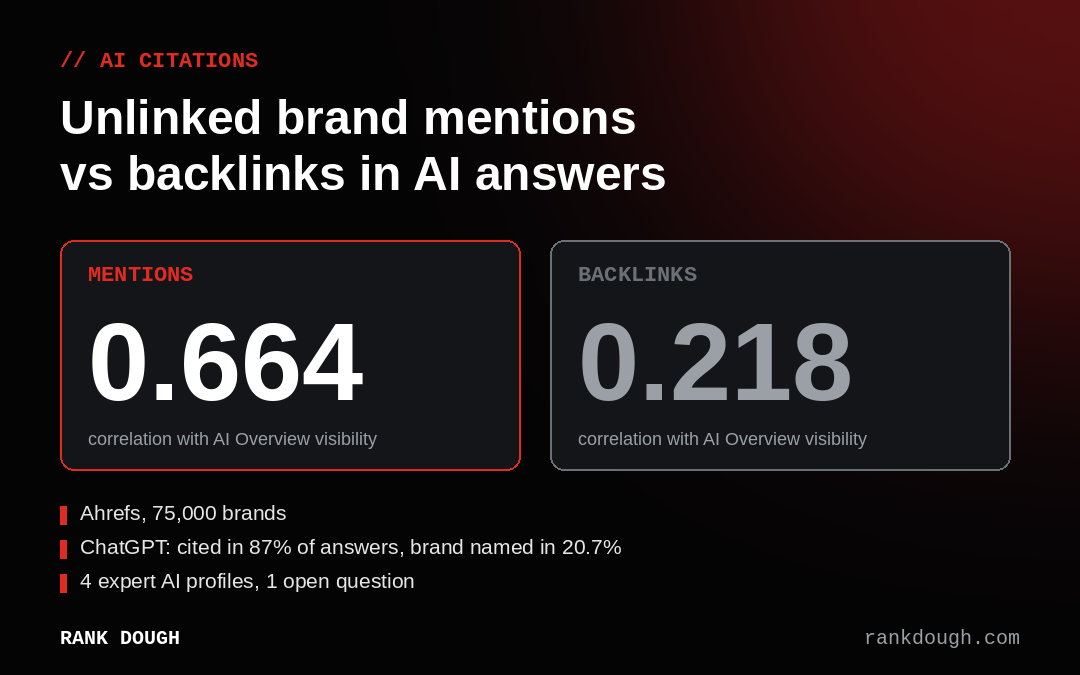
Yes for ChatGPT, on the evidence so far, but nobody has proved cause. Ahrefs found branded web mentions correlate at 0.664 with AI Overview visibility across 75,000 brands, against 0.218 for backlinks.
Rank Dough’s own test on six custom softball jersey prompts found zero overlap between the pages ChatGPT cited and Google’s top 10. Every study I could find is correlational, so treat mentions on the right pages as the best bet you have, and test it on your own brand.
TL;DR
Mentions of your brand on pages that AI engines already retrieve correlate with AI visibility three times more strongly than backlinks do. A mention only helps if it sits on a URL the engine pulls for your prompts, and it helps most when your brand name sits right next to a specific claim. Nobody has run a controlled test yet, so measure mention rate and citation rate separately and use a holdout before you spend a big budget.
How this was researched
The work behind the numbers, so you can judge them for yourself.
EFFORT
Three studies, one test
Read Ahrefs’ 75,000-brand study, Semrush’s ghost citations study and AirOps’ data, then checked them against our own ChatGPT runs on 1 and 7 September 2026.
ORIGINALITY
Published data plus our own
The studies are public. Setting them against a live first-party test in one market is ours.
SKILL
Run by an SEO, not a tool
Written by Roman Sadowski, Rank Dough’s SEO lead, who runs AI citation tests for client brands.
ACCURACY
Correlation, not cause
The big studies show correlation. Nobody has run a controlled test, and our own sample is small and in one vertical.
Why did I put this question to four expert AI profiles?
I wanted more than the usual “mentions are the new links” posts. So I took one question to SuperMe, a network that builds AI profiles of experts from their talks, writing and notes, and lets you compare several of them on one question.
I asked the AI profiles of Ethan Smith (Graphite), Kevin Indig (Growth Memo), Alex Halliday (AirOps) and Eli Schwartz the same thing: do unlinked brand mentions get a brand cited in ChatGPT and Google AI Overviews?
Read their answers for what they are. An AI profile summarises what an expert has published and said.
It isn’t the person. Every time I quote one below, I label it “AI profile”, and I’ve only kept numbers I could trace back to the expert’s own published study. Where a profile gave a figure I couldn’t verify, I left it out.
Then I checked their answers against our own test data from September 2026. That’s the part you won’t find anywhere else.
What does the public data say about mentions versus links?
Three published studies carry most of the weight in this debate. They all point the same way, and they all measure correlation.
| Study | Sample | Finding | Figure |
|---|---|---|---|
| Ahrefs, AI Overview brand factors | 75,000 brands | Correlation of branded web mentions with AI Overview visibility | 0.664 |
| Ahrefs, AI Overview brand factors | 75,000 brands | Correlation of backlinks with AI Overview visibility | 0.218 |
| Semrush and Kevin Indig, ghost citations | 3,981 domain appearances, 115 prompts, 14 countries | Citations where the brand was linked but never named | 61.7% |
| Semrush and Kevin Indig, ghost citations | ChatGPT answers in the same sample | Answers that linked a source / answers that named the brand | 87.0% / 20.7% |
| AirOps, State of AI Search 2026 | Citations across ChatGPT, Gemini, Perplexity | Brand mentions that come from external domains | 85% |
Source: ahrefs.com/blog/ai-overview-brand-correlation/, semrush.com/blog/the-ghost-citations-study/, airops.com/lp/the-state-of-aeo-report. Checked 6 October 2026.
I pulled each figure from the original study page on 6 October 2026 and dropped any number I couldn’t trace back to its source.
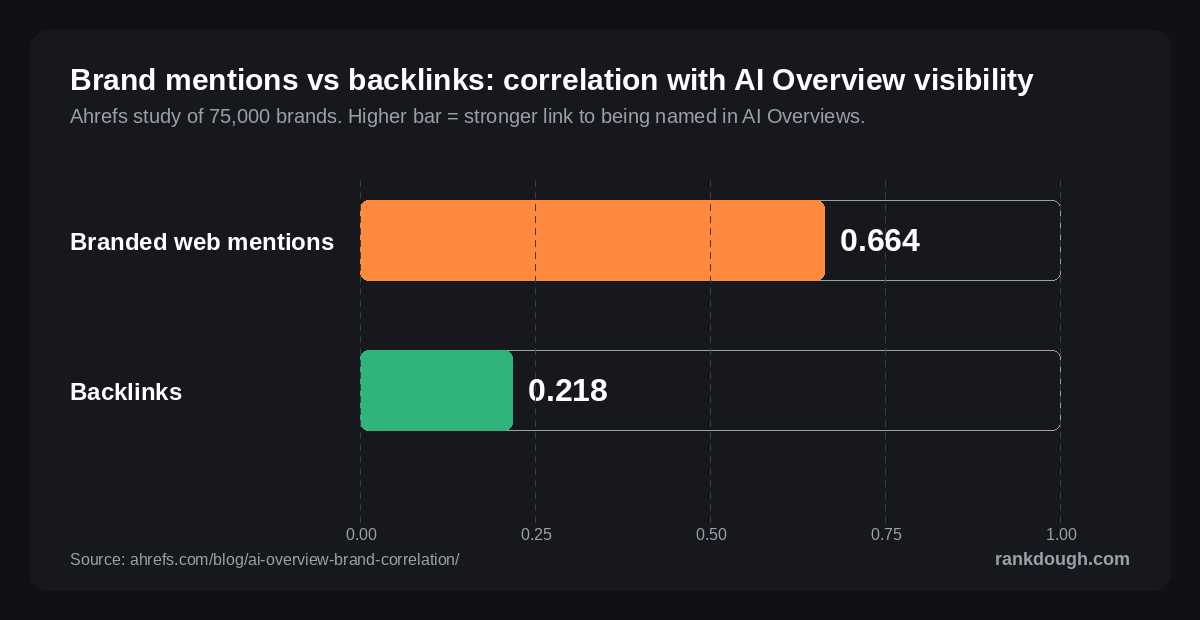
The Ahrefs gap is the headline. Mentions, linked or unlinked, track AI Overview visibility three times more closely than backlink counts.
The AirOps figure tells you where those mentions live: on other people’s sites, not yours. So for most brands, the work that moves AI visibility happens off-site.
What did our own softball jersey test find?
In September 2026, Rank Dough ran a small citation test on a custom softball jersey store. We put six buying prompts through ChatGPT, logged every result it retrieved and every page it cited, and compared that with Google’s top 10 for the same terms. We reran it a week later with a retrieval audit.
| What we measured | Result |
|---|---|
| Buying prompts tested | 6 |
| ChatGPT citations that also sat in Google’s top 10 | 0 |
| Retrieval pools that contained Reddit results | 12 of 12 |
| Results cited in two runs where ChatGPT opened no pages | 5 of 17 and 6 of 16 |
| Citations that repeated a week later | 5 of 18 |
Source: Rank Dough first-party test, custom jersey vertical, 1 and 7 September 2026. Small sample, one vertical.
Three things stood out. First, ranking first in Google predicted nothing here.
Second, Reddit showed up in every retrieval pool but rarely got the citation. Third, ChatGPT never searched the words we typed.
It rewrote each prompt and added buyer criteria like “minimum order”, “turnaround” and “youth sizing”.
For a small brand, that last point matters most. The pages ChatGPT pulls are the ones that answer those rewritten queries. If a roundup page already ranks for “custom softball jerseys low minimum order”, a mention on that page with your minimum stated next to your name is worth far more than a link from a big site that never comes up.
Where do the four expert AI profiles agree?
On four points, all four profiles landed in the same place.
- The page matters more than the domain. A mention helps only if it sits on a URL the engine retrieves for your prompts. The Ethan Smith profile put it plainly: a mention on a big site’s page that never gets cited does nothing for you.
- “Go win Reddit” is weak advice. All four profiles rejected it. That matches our test: Reddit made every pool and still lost most of the citations.
- Track mentions and citations as two numbers. A citation means the engine used your page. A mention means a buyer read your name. They move separately.
- Nobody has proved cause. The Kevin Indig profile said it straight: a cross-sectional chart can’t tell you whether mentions drive visibility or whether strong brands collect both.
Where do the expert AI profiles disagree?
The first split is about links. The Eli Schwartz profile said he tells companies to pause paid link campaigns and has never seen it hurt them.
But he and the Ethan Smith profile both made one exception: brands with little awareness still benefit from earned links. That’s the exception that matters for small ecommerce brands, and it’s the one the big studies can’t speak to, because their samples lean on well-known brands.
The second split is about measurement. The Ethan Smith profile argued that most citation tracking measures a layer that often doesn’t exist.
When ChatGPT answers without searching, there are no citations at all. The answer then rests on how often the model has seen your brand next to your category across the web.
Tracking tools that force a search can show you a very different picture from what a buyer sees. The Alex Halliday profile accepted that point, which narrows what any citation study can claim.
Why does a ghost citation matter if you still get the link?
Because buyers act on names, not footnotes. Kevin Indig’s AI Mode user study followed 48 people through 185 high-stakes purchase tasks. 74% of them chose the item the AI ranked first, and 64% clicked nothing at all. If the answer links your page but names a competitor, the competitor gets the sale.
The Alex Halliday profile described what gets a brand named rather than just linked: the brand name sits right next to the claim. “Brand X is the best option for youth leagues because the minimum order is 10” survives extraction.
“A recent study found the minimum is 10” lets the model lift the fact and drop your name. Our own test agrees.
The sentences ChatGPT lifted whole were the ones that carried brand, product, audience, turnaround and price in one line.
What should a small ecommerce brand do first?
Here’s the order I’d work in, based on the evidence above and our own test. Treat the order as my judgement, not a proven sequence.
- Map the pages first. Run your real buying prompts several times on each engine. Record every third-party page that gets retrieved and cited. Each engine pulls a different set.
- Rank those pages by how often they appear. Work down the list from the top.
- Ask for a sentence, not a logo. Get your brand named next to one specific use case and one number: “best for youth teams, minimum order of 10”.
- Repeat one claim. Five pages that say you’re best for the same use case beat twenty loose mentions.
- Fix your own pages for the rewritten queries. Put minimums, turnaround, pricing and sizing in plain text near the top, so third parties have something to quote.
- Keep earned links in the plan. If nobody knows your brand yet, links still help your own pages win the follow-up questions.
How would you prove mentions cause citations?
You’d need a test with controls, and nobody I could find has published one. Two of the AI profiles described designs, and they control for different things.
The Ethan Smith profile splits the cited URLs into treatment and holdout groups. The Kevin Indig profile compares the brand against matched brands that get no new mentions, and checks that any lift shows up only on the prompts you targeted.
The test I’d run combines both:
- One low-awareness brand in one narrow category, such as custom softball jerseys.
- Cited URLs split into treatment and holdout within high, mid and low citation-frequency buckets.
- Targeted prompts compared with untargeted prompts for the same brand.
- Two or three matched brands of similar size as controls.
- Mention rate, citation rate and ghost citation rate tracked separately, on forced and unforced runs, several times a week.
- At least three months, with every placement date logged, and tracking kept running after outreach stops to see how fast any lift fades.
A lift that appears only on targeted prompts, only after placement and only for the test brand would be real evidence. Anything less is another correlation. Rank Dough is planning this test on the custom kit vertical, and I’ll publish the results here.
Frequently asked questions about unlinked brand mentions
What is an unlinked brand mention?
An unlinked brand mention is any place your brand name appears on another site without a hyperlink to you. Ahrefs counts linked and unlinked mentions together in its 0.664 correlation with AI Overview visibility, which is why unlinked mentions now matter for AI search.
Do backlinks still matter for AI Overviews?
Yes, but less than mentions. Ahrefs found backlinks correlate at 0.218 with AI Overview visibility, a positive but weaker link. Links still help your own pages rank, and brands with little awareness benefit from earned links most.
What is a ghost citation?
A ghost citation is when an AI engine links your page as a source but never names your brand in the answer. Semrush and Kevin Indig found 61.7% of citations across four engines work this way, and ChatGPT named the brand in only 20.7% of answers.
Should I pay for Reddit comments to get into ChatGPT?
No. In our September 2026 test, Reddit appeared in 12 of 12 ChatGPT retrieval pools but rarely won the citation. All four expert AI profiles also advised against it, and seeded comments sit next to years of older, genuine threads.
How long before a new mention shows up in AI answers?
Nobody has published a reliable figure. In our test, only 5 of 18 citations repeated a week later, so answers rotate fast. Measure share across many runs over at least three months rather than checking a single answer.
Sources
- Ahrefs, An Analysis of AI Overview Brand Visibility Factors (75K Brands Studied): ahrefs.com/blog/ai-overview-brand-correlation/
- SuperMe AI profiles of Ethan Smith, Kevin Indig, Alex Halliday and Eli Schwartz, answers collected 6 October 2026 (AI summaries of each expert’s published work, not the experts themselves)
- Rank Dough first-party citation test, custom jersey vertical, 1 and 7 September 2026
