
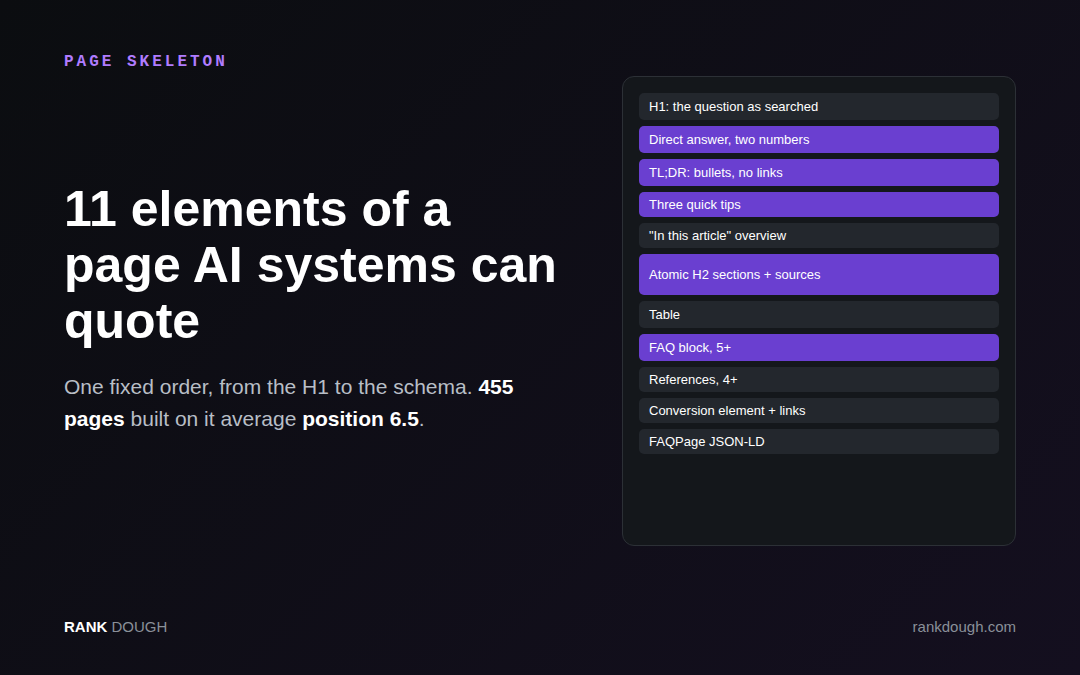
TL;DR: Every article my system produces follows one skeleton of eleven elements, in a fixed order, from the H1 to the schema block. It has not changed in shape since 30 January 2026; the rules inside each element have tightened. The skeleton is what lets a Shopify blog with no backlinks reach page one in under 60 days: 455 pages on trackbarn.com average position 6.5, and the Italian pages on dentaltourismalbania.com built from the same skeleton rank at positions 2 to 5 in Italy. This article walks through each element, what it is for, and why the order matters.
Why a fixed skeleton
A skeleton does two things a style guide cannot. It makes every page extractable in the same way, so an answer system that learns where the answer sits on one page finds it in the same place on the next. And it makes quality checkable: a rule like “one table per 600 to 1,000 words” can be counted; “use tables where helpful” cannot.
The trade-off is that the skeleton has to be right, because it is applied hundreds of times. It was derived from one reference article on 30 January 2026 and the elements have held since. What changed over the following months is the rule inside each element: how many numbers the opening carries, how many FAQs, what a section must contain. The shape did not move.
The eleven elements, in order
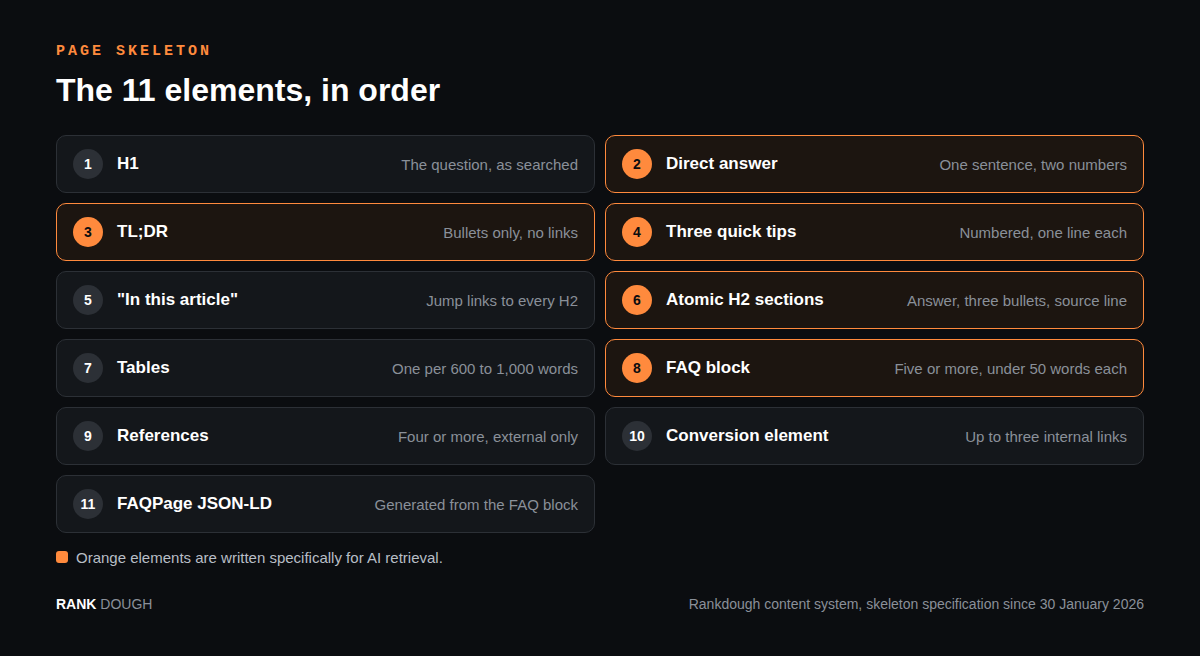
Each element has one job. If it is not doing that job on a given page, it is removed rather than filled.
- H1: the question, as searched. The title is the query string, not a rewording of it. “What is a good 5k time for cross country” stays exactly that. Answer systems match on the question; a clever title costs the match.
- Direct answer paragraph. One sentence that answers the H1 and carries at least two numbers. This is the retrievable unit and the reason the page exists. Rule live 12 June 2026.
- TL;DR as an H2, bullets only, no links. The answer again, expanded to three to five bullets with the same figures. No links, because a summary a model lifts whole should not carry the reader away. Coloured background so a human skimmer sees it.
- Three quick tips. Numbered, one line each, actionable. This block is the one most often lifted into People Also Ask and answer overviews, because it is short and imperative.
- “In this article” numbered overview. Jump links to every H2. For readers it is navigation. For crawlers it is an entity map of the page: every concept the page covers, named once, linked once.
- Atomic H2 sections. Each H2 is a question or a claim. The first line under it answers the heading on its own. Three bullets follow, then a source line. A section must survive being extracted without the rest of the page around it.
- Tables: one per 600 to 1,000 words, never single-row. Structured comparisons are the second most extracted element after the opening. A single-row table is a sentence pretending to be data and is rejected.
- FAQ block: minimum five questions, before the closing section. Each answer under 50 words. The five questions are drawn from the silo’s question keywords, so they capture long-tail queries the H2s do not.
- References: minimum four, external only. Never the client’s own domain. Low-authority sources rejected at brief stage. Every link fetched before publish.
- Conversion element and internal links. A block the reader needs to complete the task, placed where the task ends. Up to three internal links to product or service pages, none to the homepage, none in the TL;DR.
- FAQPage JSON-LD. Generated from the FAQ block, not written separately, so it cannot drift from the visible text.
The rules inside the elements
The skeleton is the frame. The rules are what tightened between January and June:
- Sentence length: 12 to 15 words on average, set 16 April 2026 after readability review. Paragraphs are split at four sentences unless a figure, list or table breaks them.
- Information gain: five sourced data points per article, three in the first 30 percent. Raised from three on 29 May.
- Non-commodity check: title and every section must state something a generic article would not. Seven automated checks from 29 May.
- FAQs: minimum five, enforced 4 June after articles shipped with three.
- Numeric opening: two numerical elements in the direct answer and the TL;DR, from 12 June.
- Colour palette taken from the client’s site so the page looks native when pasted into Shopify or WordPress.
Each rule is checked by an independent pass that reads the finished HTML. The writer does not certify its own compliance.
Proof the skeleton travels
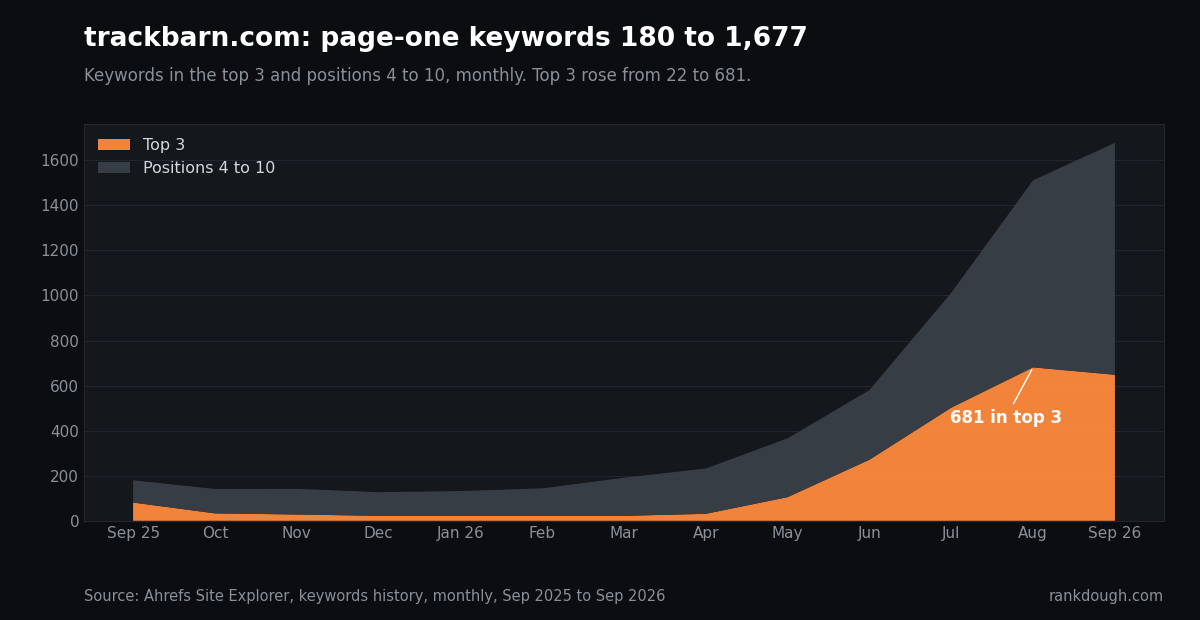
The strongest evidence that the skeleton, rather than any one page, is doing the work is that it ranks in a second language on a second site.
The Italian pages on dentaltourismalbania.com under /it/faq/ use the identical eleven elements. In the Ahrefs top pages report for 22 September 2026: “gengiva bianca dopo estrazione” at position 5, “acqua e sale dopo estrazione dente” at position 2, “elastici invisalign” at position 5, “spicola ossea dopo estrazione dente” at position 8, “pulire la dentiera con il bicarbonato” at position 10. These were built last and cost the least to produce, and they rank in the market the client sells into.
On trackbarn.com the same skeleton in programmatic mode, at 100 to 500 words a page, produced 455 pages averaging position 6.5 across 1.3 million monthly impressions. 121 of them earn ten or more clicks a month. No links were built to any of them.
What the skeleton does not fix
Three things sit outside it and decide whether a page pays.
Which question gets a page. The skeleton makes any question rank; it cannot tell you whether the searcher is a customer. That is the buyer-distance score, applied before the brief.
Whether the click happens. Answer-first pages are often read in the results without a visit. On TrackBarn the pages average 0.36 percent CTR at position 6.5. The skeleton earns the position and the citation; the click depends on whether the page has something the results cannot show.
Duplicates. Two pages built to the same skeleton on the same intent split the ranking. The skeleton does not know about its siblings; the dedupe step has to.
How to adopt the skeleton
- Fix the order first. Elements can be tuned later; a moving shape cannot be measured.
- Make every rule countable. “At least five FAQs” can be checked by a script. “Enough FAQs” cannot.
- Put the check outside the writer. Whoever produced the page does not sign it off.
- Generate schema from the visible FAQ block, never by hand, so the two cannot disagree.
- Pull the palette from the client site so exported HTML needs no design pass.
Work with us: this skeleton is the base of our content service and our AI Visibility Programme. See it at scale in the TrackBarn case study.
FAQ
Why is the H1 the exact query rather than a better headline?
Answer systems match passages to the question as asked. A rewritten headline weakens the match. The H1 is for retrieval; the direct answer beneath it is for the reader.
Why no links in the TL;DR?
The TL;DR is written to be lifted whole into an answer. Links inside it fragment the block and send readers away before the page has made its case.
Why a minimum of five FAQs?
Five questions from the silo capture long-tail queries the H2s do not, and populate FAQPage schema with enough entries to earn a rich result. Articles shipped with three were measurably thinner in query coverage.
Does the skeleton work at 300 words?
Yes, in programmatic mode: direct answer, short TL;DR, one section, one table, five FAQs. That is how the 455 TrackBarn pages were built.
Can the skeleton be applied to existing pages?
Yes. An “apply format” mode takes existing HTML and rebuilds it into the eleven elements without regenerating the facts. It is how migrated pages were brought into line.
Sources
- Ahrefs Site Explorer, top pages, dentaltourismalbania.com, 22 September 2026
- Google Search Console, trackbarn.com, Pages report, 28 days to 22 September 2026
- Rankdough content system build record, skeleton specification and rule changes, 30 January to 12 June 2026
