
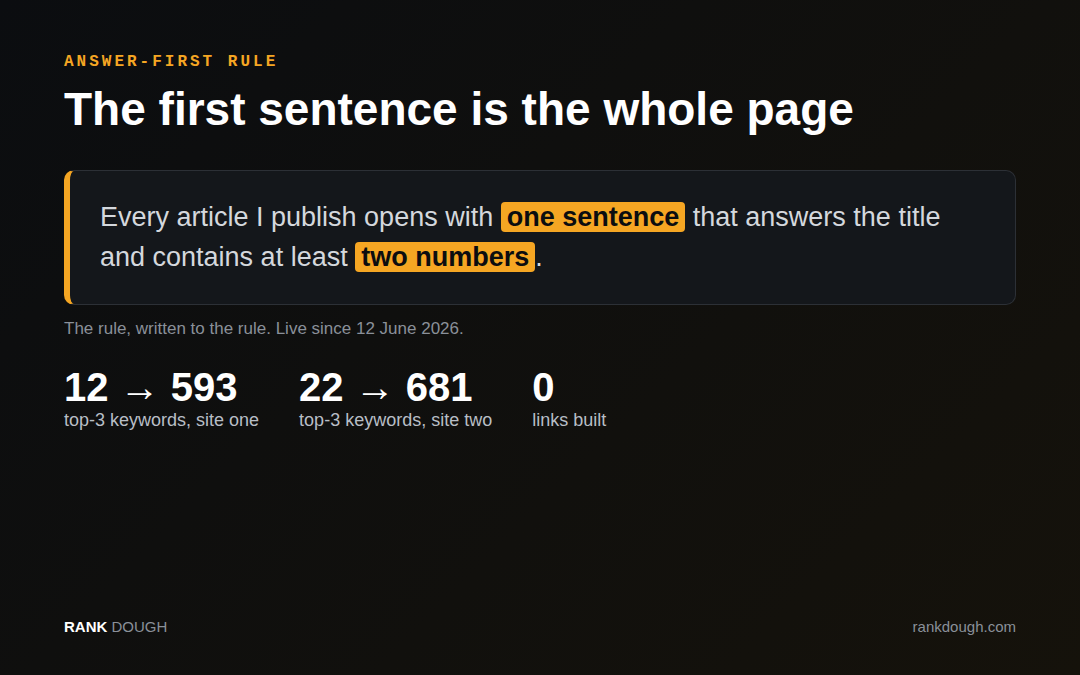
TL;DR: Every article I publish opens with one sentence that answers the title and contains at least two numbers. I made that a hard rule on 12 June 2026. Since the rule went live, dentaltourismalbania.com went from 12 keywords in the top 3 to 593 at peak, and trackbarn.com from 22 to 681. Neither site built links. The opening sentence is the unit that search engines and AI answer systems retrieve, and this article explains how I write it, why numbers matter, and what the rankings look like when the rule holds.
Why the first sentence decides whether a page is retrieved
An AI answer system does not read a page the way a person does. It pulls passages that match a question and scores them on how directly they answer it. A passage that begins with a claim and a figure scores higher than one that begins with context. Google’s answer features behave the same way: the passage lifted into a snippet or an overview is almost always the one that states the answer in its first line.
So the first sentence of an article is not an introduction. It is the retrievable unit. Everything after it supports that unit or extends it. If the first sentence hedges, defers, or sets the scene, the page has already lost the extraction to a competitor whose first sentence did not.
On dentaltourismalbania.com, the page “when can you eat after tooth extraction” ranks at position 2 in the United Kingdom and earns an estimated 144 visits a month. Its opening states a time window in hours and a day count. The NHS and Bupa both rank on the same query. A marketplace site outranks them because its first line is more extractable, not because it has more authority.
The rule, exactly as the system applies it
The generation system checks each article against four conditions before it passes:
- The first paragraph contains a single sentence that answers the H1 as asked. Not “it depends”, not “there are several factors”.
- That sentence, or the paragraph it opens, carries at least two numerical elements: a figure, a percentage, a date, a duration, a price, a count.
- The TL;DR block that follows repeats the answer in bullet form with the same numbers, and contains no links.
- No section heading is phrased as a topic. Every H2 is a question or a claim, and the first line under it answers the heading on its own.
Condition two went live on 12 June 2026 after I reviewed a batch of dental aftercare pages that ranked but did not hold position. The pages with a specific figure in the opening held; the pages that opened with reassurance drifted. Since then the two-number floor has been mandatory. Information gain was raised alongside it: a minimum of five concrete data points per article, with three of them inside the first 30 percent of the text.
What the rankings did once the rule held
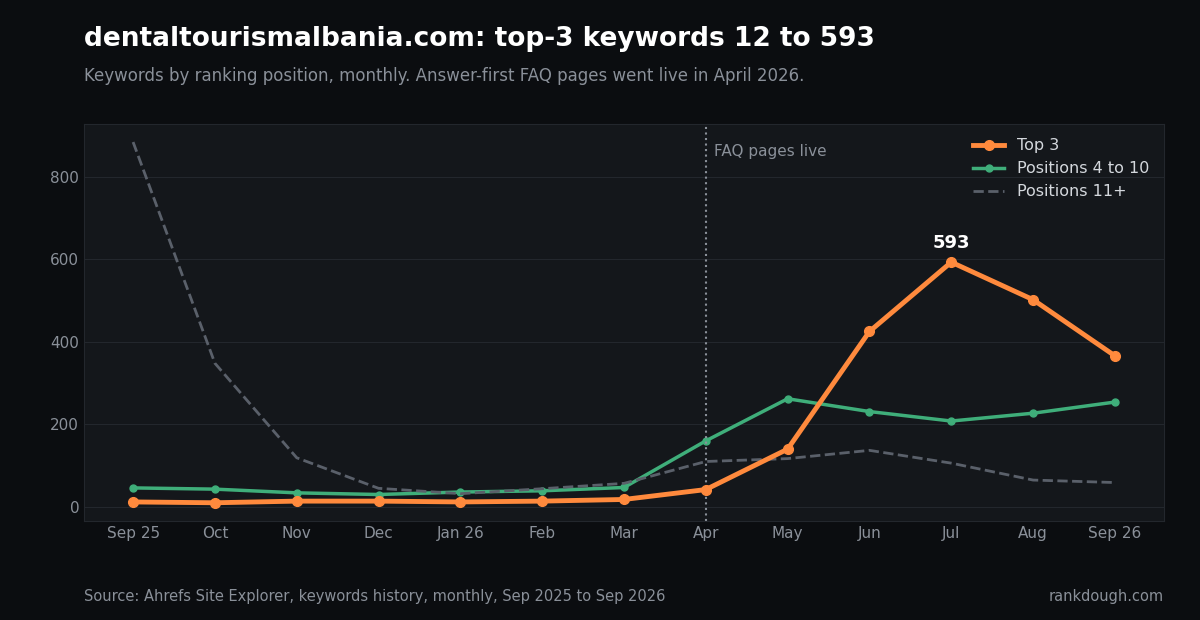
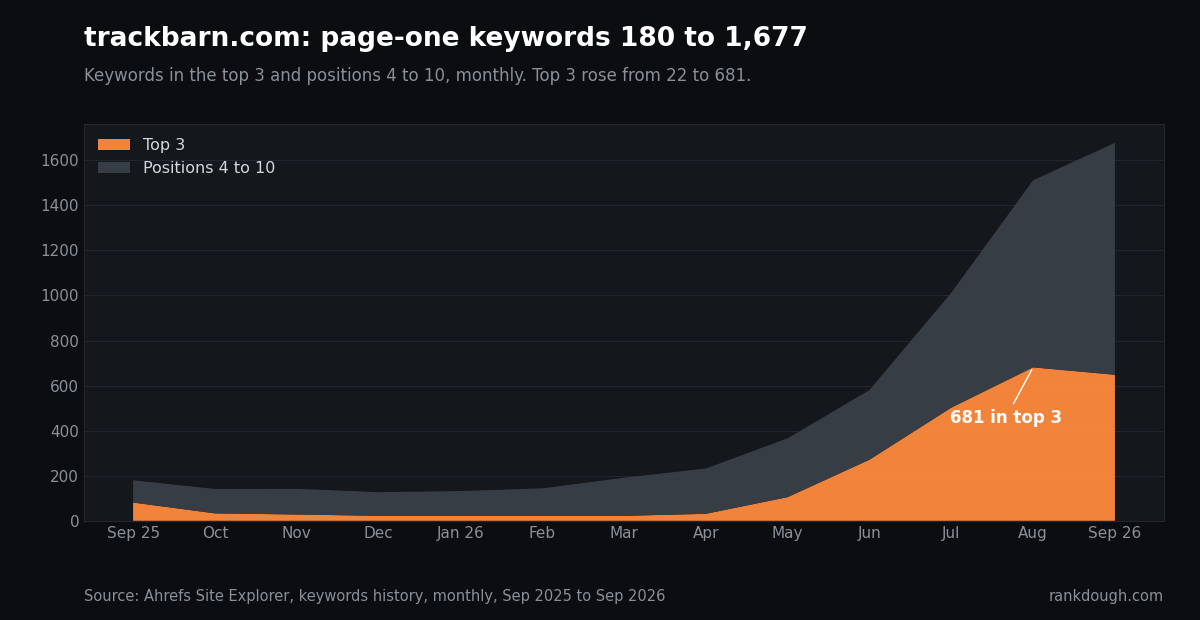
The clearest signal is the number of keywords each site holds in the top three positions. In September 2025 dentaltourismalbania.com had 12. By April 2026, when the first answer-first FAQ pages went live, it had 42. By July it had 593. TrackBarn moved from 22 in March to 681 in August.
Top-3 positions are the ones that feed answer features. A page at position 7 is rarely extracted. A page at position 2 with a numeric first sentence is extracted routinely. That is why I track the top-3 count separately from total page-one keywords.
Ahrefs also shows the long tail collapsing. dentaltourismalbania.com had 884 keywords ranking at position 11 or worse in September 2025 and 59 a year later. Weak pages that ranked on page two or three were replaced by a smaller set of pages that rank on page one. That is what a retrieval-first rewrite does: fewer pages, stronger positions.
How I write the sentence
The method is mechanical, which is the point. A rule that depends on inspiration does not survive 455 pages.
- Take the H1 as the searcher typed it. “What is a good 5k time for cross country” stays exactly that. No rewording for style.
- Pull the two strongest figures from the research brief. For a 5k time page: a time in minutes and seconds, and the age or grade it applies to.
- Write one sentence that would satisfy the searcher if it were the only thing they read. Subject, verb, figure, condition. Nothing before the subject.
- Test it by removing the rest of the page. If the sentence alone would be a reasonable answer in a chat window, it passes.
- Repeat the answer in the TL;DR with the same numbers, then spend the rest of the page on the conditions, exceptions and next steps.
The TrackBarn page “what is a good 5k time for cross country” ranks at position 4.3 and drew 38,847 impressions in 28 days. “How far does middle school cross country run” ranks at 3.6. Both open with a distance or a time in the first line. Both reached page one inside 60 days of publishing on a Shopify blog with no backlinks.
What the rule does not do
It does not win the click by itself. On trackbarn.com the same pages that rank at positions 3 to 6 earn 0.3 to 0.7 percent click-through rate, because the answer is visible in the results and the reader is satisfied there. I cover that pattern in a separate article on position and CTR. The point here is narrower: the rule earns the position and the citation. Whether the position pays depends on how close the query sits to a purchase, which is a planning decision made before writing, not a writing rule.
It also does not replace evidence. A number in the first sentence has to come from the research brief attached to the article, with a source line under the section that uses it. A made-up figure in the opening is worse than no figure, because it will be extracted and repeated.
What to check on your own pages
- Read only the first sentence of your ten most important informational pages. Would each one stand as an answer on its own?
- Count the numbers in each opening paragraph. Fewer than two means the passage is competing on prose, and prose loses extraction to figures.
- Look at your top-3 keyword count in Ahrefs or Search Console, month by month. If page-one keywords are growing but top-3 is flat, the pages rank on relevance and lose on extractability.
Work with us: this opening-sentence rule runs every article in our content service. See it at scale in the TrackBarn case study.
FAQ
Does the two-number rule apply to every type of page?
To every informational page, yes. Product and service pages open with the offer instead. The rule exists for pages that answer a question, because those are the pages AI systems extract from.
What counts as a numerical element?
A figure, percentage, date, duration, price, count or measurement. “A few days” does not count. “Three to five days” does.
How quickly do answer-first pages reach page one?
On both sites, inside 60 days of publishing without link building. dentaltourismalbania.com moved from 18 to 425 top-3 keywords in the three months after launch.
Does this work outside English?
Yes. The Italian pages on dentaltourismalbania.com follow the same rule and rank at positions 2 to 5 in Italy for queries such as “acqua e sale dopo estrazione dente”.
What happens if the research brief has no numbers?
The page is not written. A question that cannot be answered with figures is either the wrong question or the brief is too thin. Either way it goes back a step.
Sources
- Ahrefs Site Explorer, keywords history by position band, dentaltourismalbania.com and trackbarn.com, monthly, September 2025 to September 2026
- Ahrefs Site Explorer, top pages, dentaltourismalbania.com, 22 September 2026
- Google Search Console, trackbarn.com, Pages report, 28 days to 22 September 2026
