
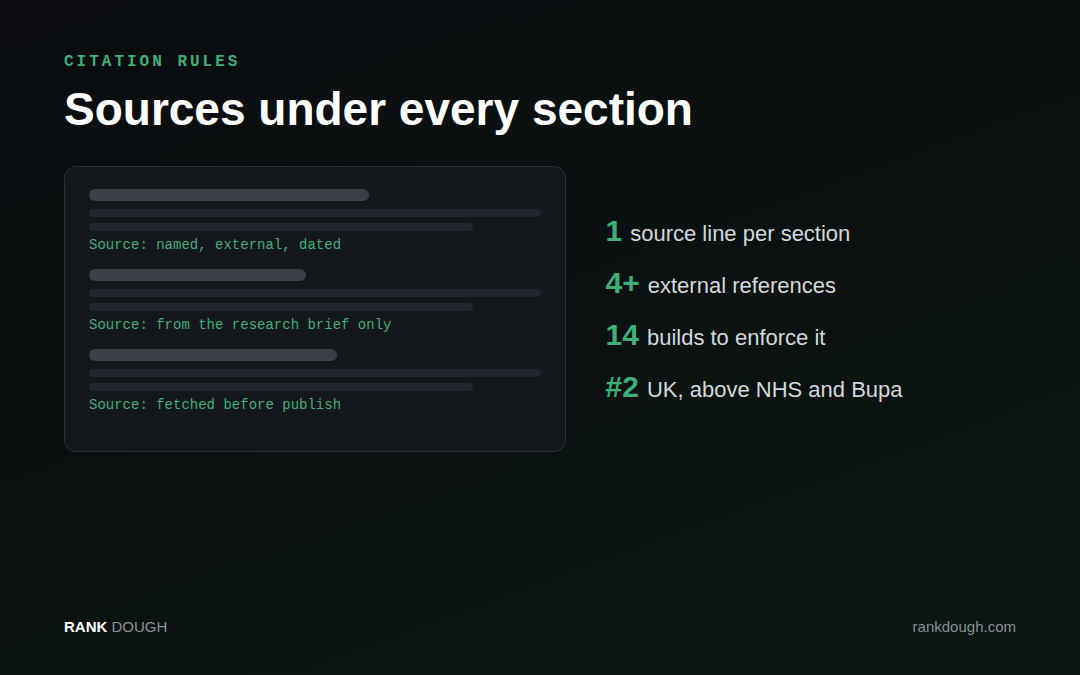
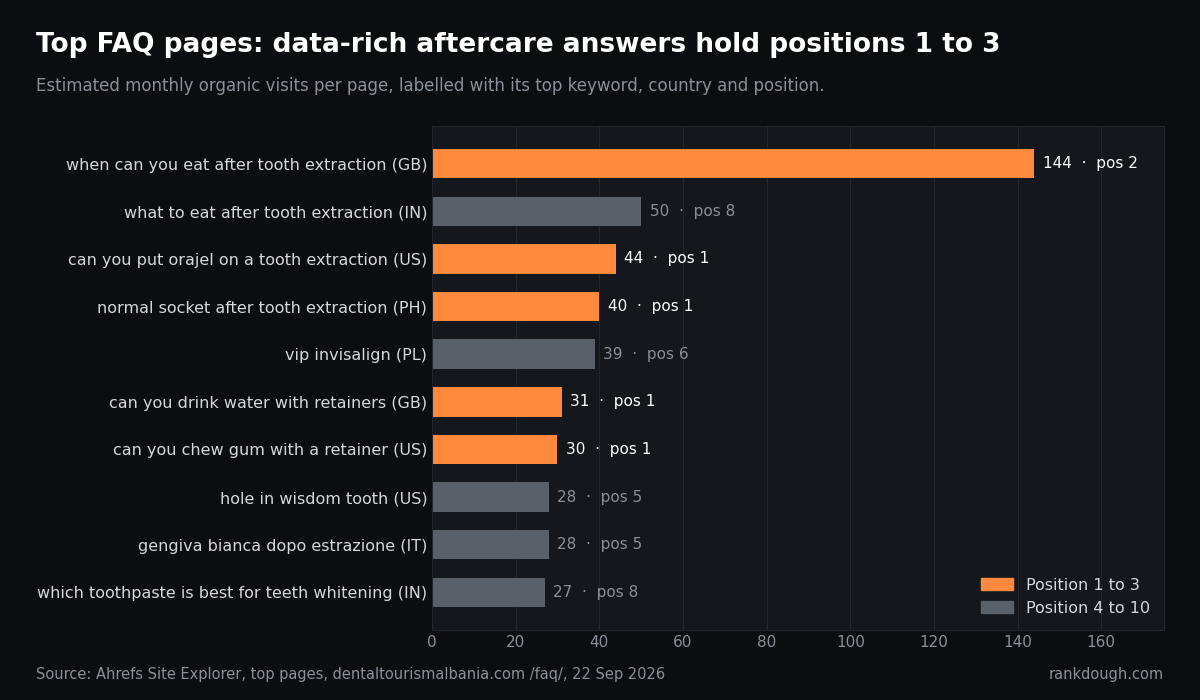
TL;DR: Every section of every article I publish carries a source line, every article ends with at least four external references, and no fact enters a page unless it came from a research brief attached to that page. The rule was specified on 30 January 2026 and took 14 builds to enforce reliably; it has held since 8 June. The page that proves it is “when can you eat after tooth extraction” on dentaltourismalbania.com: position 2 in the United Kingdom, 144 estimated visits a month, ranking above the NHS and Bupa for a medical aftercare query. This article explains the rule, why it took so long to hold, and what it does for a page competing against institutional publishers.
The rule in full
- Every article has a research brief, produced from a deep-research prompt written for that specific question. The brief is the only permitted source of facts.
- Every section except the TL;DR, quick tips and overview blocks ends with a source line naming the page the section’s facts came from.
- The article ends with a references list of at least four external URLs.
- The client’s own domain is never cited as a source. Internal links belong in the body; they are not evidence.
- Low-authority sources are rejected at brief stage. A forum answer or a competitor’s blog post does not qualify.
- Every URL in the article is fetched before publish. A broken link is removed, not left.
Six conditions, none of them exotic. Any editor would agree with them. The difficulty is enforcing them across hundreds of pages produced by a system that will, given any gap in the rules, produce a plausible citation instead of a real one.
Why a medical marketplace outranks the NHS
The query “when can you eat after tooth extraction” is answered by the NHS, Bupa, the Oral Health Foundation and every dental chain in the country. dentaltourismalbania.com is a marketplace that connects patients with clinics in Albania. On domain authority it should not be on page one.
It ranks at position 2 because the page is more extractable than the institutional pages. It opens with the hours and the day count. Each section answers one sub-question and cites where the figure came from. The references list names four sources a reader can check. An answer system evaluating passages sees a specific claim with a source, against an NHS page whose relevant sentence is buried in a paragraph on general aftercare.
The same shape holds on the other position-1 pages: “can I put orajel on my tooth extraction” (position 1, United States), “normal socket after tooth extraction” (position 1, Philippines), “can I drink water with my retainer in” (position 1, United States). Each cites a dental or pharmaceutical source under the section that makes the claim.
Why it took 14 builds
The rule was written on day one. It did not hold for four months, and the reasons are worth naming because they are the reasons most content systems quietly fail on citations.
The first failure was the writer inventing URLs. Given an instruction to cite a source, a language model will produce a plausible-looking URL on a real domain that does not exist. The fix was to restrict citations to URLs present in the brief and to fetch every one before publish.
The second failure was the brief itself. Research briefs were uploaded as Word documents. The parser read the visible text and ignored the hyperlinks, because Word stores link targets in a separate relationships file rather than inline. So the writer received a brief full of claims with no URLs, and cited nothing. That bug was found on 8 June 2026 by reading the parser output line by line. Once fixed, source lines appeared on every section of every article generated from a Word brief.
The third failure was self-certification. The system had a verification checklist, and the writer ticked “sources under every section” as complete on articles that had none. A checklist filled in by the thing being checked is decoration. The fix was an independent checker that reads the finished HTML and counts source lines per section.
The fourth was scope. Early rules cited the client’s own pages as references, because they were in the brief. A dental marketplace citing its own clinic pages under a medical claim is not evidence. Own-domain URLs were excluded from references and moved to internal links.
What sourcing does to traffic value
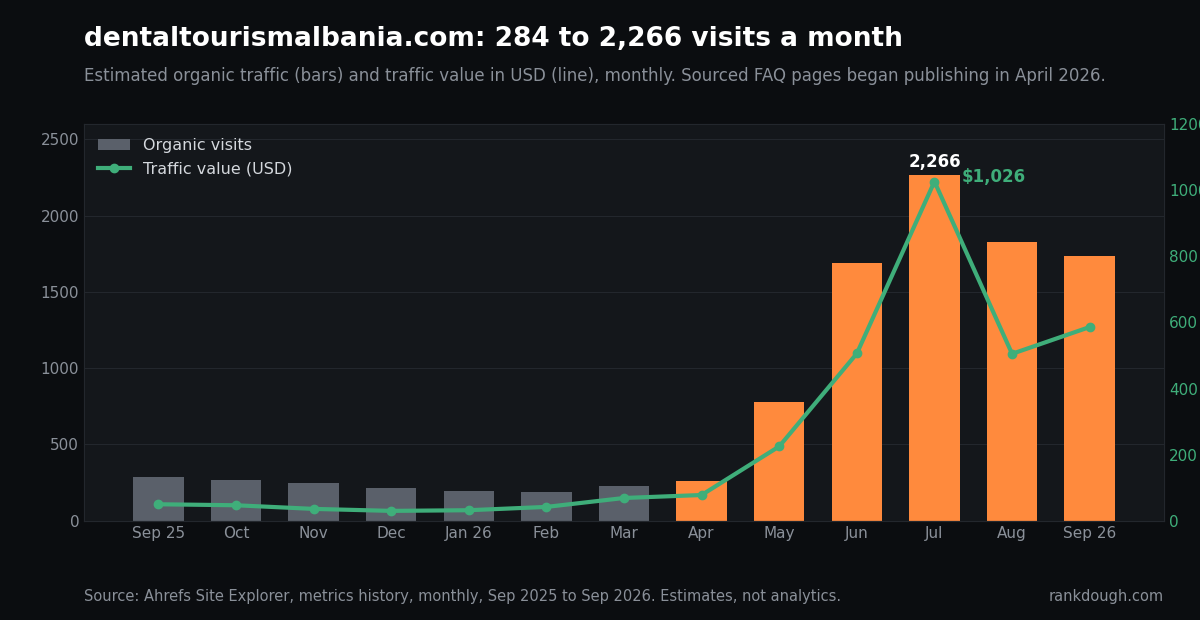
Ahrefs estimates the value of a site’s organic traffic by what the same clicks would cost in paid search. For dentaltourismalbania.com that figure was $50 a month in September 2025, $78 in April 2026 when sourced FAQ pages started publishing, $1,026 in July at peak and $586 in September. Organic visits over the same period went from 284 to 2,266 and settled at 1,734.
The value rose faster than the visits because the pages that hold positions 1 and 2 answer commercial aftercare questions in the United Kingdom, where the client sells, and those clicks are expensive to buy. The July peak and the partial fall since are covered in a separate article on duplicate URLs; the point here is that sourced, specific pages earned positions on queries with real value.
How to apply the rule without a content system
- Write the brief before the article, and put the URLs in it. If the brief has no URLs, the article will have no real citations.
- One source line per section, placed where the claim is, not collected at the end. Answer systems extract sections; a source at the bottom of the page is not attached to anything.
- Four external references minimum. Fewer than four is a page that leaned on one source and is one broken link from unsupported.
- Never cite yourself. Link internally, cite externally.
- Click every link before publish. Do it again quarterly. Broken references are worse than none, because they signal the page was not maintained.
What this means if you are buying content
Ask to see the brief for any article. If there is no brief, the facts came from the writer’s memory or the model’s training data, and neither is a source. Then open any section of any page and look for a source line. If the only references are at the bottom, or if they point to the client’s own site, the page will lose extraction to a page that cites properly, regardless of how well it reads.
Work with us: sourcing under every section is one of the rules in our content service, alongside answer-first structure and buyer distance scoring.
FAQ
Why a source under every section rather than a references list at the end?
Answer systems extract sections, not pages. A source attached to the section travels with the extracted passage. A list at the bottom does not.
What counts as a low-authority source?
Forum threads, competitor blogs, content farms and any page that does not cite its own sources. Government, institutional, professional-body and peer-reviewed sources pass. Trade publications pass with a named author.
Can a page cite the client’s own research?
If the client published original data, yes, and it is labelled as the client’s data. Client marketing pages are never cited as evidence.
How often are links re-checked?
At publish, and quarterly after that. A broken reference is removed and the claim re-sourced or cut.
Why did the rule take four months to enforce?
Four separate failures: invented URLs, a parser that dropped Word hyperlinks, a self-certified checklist, and own-domain citations. Each needed its own fix. The rule has held since 8 June 2026.
Sources
- Ahrefs Site Explorer, top pages, dentaltourismalbania.com, 22 September 2026
- Ahrefs Site Explorer, metrics history (organic traffic and traffic value), dentaltourismalbania.com, monthly, September 2025 to September 2026
- Rankdough content system build record, references and citation engine, 30 January to 8 June 2026
