
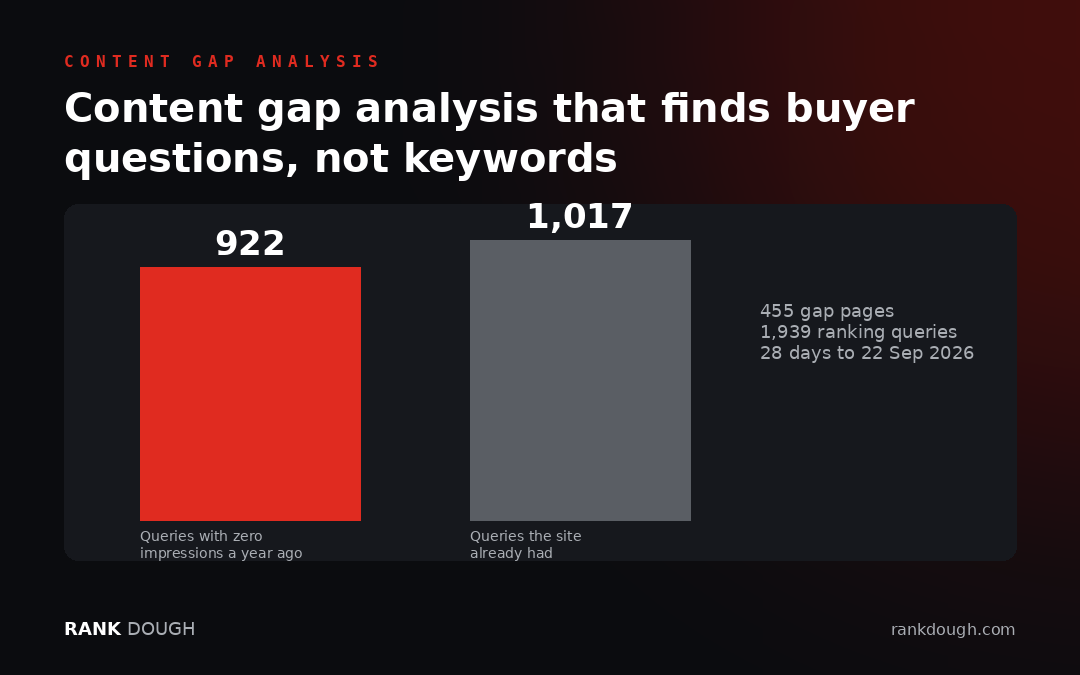
At Rank Dough we run content gap analysis as a hunt for buyer questions nobody answers with a figure, not as a list of keywords a competitor ranks for. On trackbarn.com that gave me 455 question pages ranking for 1,939 queries inside six months, 922 of them queries the site had never ranked for.
It also gave me a third of pages I would not build again. Both numbers are in here.
TL;DR
A tool export lists keywords your rival ranks for; the gap worth filling is a buyer question no page answers with a figure, and I score every candidate 0 to 3 on how far the searcher is from buying before I look at volume. Questions become articles, generic terms become collections, and nothing gets briefed until I can name the one number the page will give that nobody else does. On TrackBarn that produced 922 new ranking queries from 455 pages, and a third of pages I would not build again because I scored buyer distance after publishing instead of before.
How this was researched
The work behind the numbers, so you can judge them for yourself.
EFFORT
One method, two client sites
Applied to two live client sites over six months and measured in Search Console: 1,939 ranking queries on one, position changes page by page on the other.
ORIGINALITY
Built from our own projects
The buyer-distance score and the questions-versus-generic rule come from our own content system, not a tool.
SKILL
Run by an SEO, not a tool
Written by Roman Sadowski, who runs keyword research and content planning for Rank Dough clients.
ACCURACY
What it doesn’t prove
Two sites, not a study. The “third not worth building” was scored in hindsight, and the homepage drop has more than one possible cause.
The information gap series
- Content gap analysis that finds buyer questions, not keywords (this page)
- Information gain: one page wins when ten say the same thing
- Proprietary data: the facts an AI cannot write without you
- A content gap analysis on a real site, start to finish
What is a content gap, and what is not?
A content gap is a question a buyer asks before they buy that nobody answers with a specific, sourced figure. That is the whole definition.
It is not a keyword your competitor ranks for and you do not. A tool export with 4,000 of those is a list of other people’s pages. Most of them are either answered badly by everyone or asked by nobody who will ever buy.
The two produce different pages, which is why I care about the difference. Chase the keyword list and you get a definition and a bulleted guide for every term.
That is the most interchangeable page on the internet. Chase the unanswered question and you get a page with a number in its first sentence.
That is the page that ranks and gets quoted. Our rule is simple: if we cannot answer it with a figure, we do not write it until I can.
Source: Rank Dough content method; the questions-versus-generic rule has been hard-coded in our content system since 6 March 2026
Why does the tool export mislead?
Because it measures overlap, not need. A competitor ranking for “best softball jerseys” tells you a page exists.
It does not tell you the page answers anything. Three things go wrong in every export I have worked from.
- Volume with no buyer behind it. “What is the javelin world record” pulled 58,339 impressions in 28 days on TrackBarn. 67 clicks. Not one of those people needs an $800 vaulting pole. I built that page. It ranks. It should not exist.
- Generic terms dressed up as topics. “Dental implants” is a category page, not an article. Write an article from it and you get a definition followed by a list, which an AI answer summarises and never cites.
- Duplicates in disguise. “Can I eat chocolate after tooth extraction” and “when can I eat chocolate after tooth extraction” look like two gaps. They are one. Publishing both cost Dental Tourism Albania position 1 on the first; it was at 9 by September. Google Search Central, consolidate duplicate URLs covers how Google resolves pairs like that.
Source: Google Search Console, trackbarn.com, 28 days to 22 Sep 2026; Ahrefs top pages, dentaltourismalbania.com, 1 Jul vs 22 Sep 2026; Google Search Central, consolidate duplicate URLs
How do I find the real gaps?
Four steps, in this order, and we do not open a volume column until step four is done.
- Read the client’s site first. Homepage, prices, policies, service pages. Every gap page has to land the reader one click from something the client sells. If I cannot connect a question to a product, I do not fill it.
- Scrape three competitors and write down what they all say. That shared material is the consensus. In the finished page it gets one sentence, no more.
- List what a buyer asks next and cannot find. Cost, turnaround, minimum order, what goes wrong, which category fits them. I add these rows even at zero search volume, because they are exactly the questions an AI answer expands a prompt into.
- Split questions from generic terms. Questions go to the article list. Generic terms go to collections and landing pages. I built that split into the content system on 6 March because every article I ever wrote from a generic term came out as a commodity page.
Then, and only then, we pull volume, difficulty and current rankings from Ahrefs. They order the queue. They never decide what gets in.
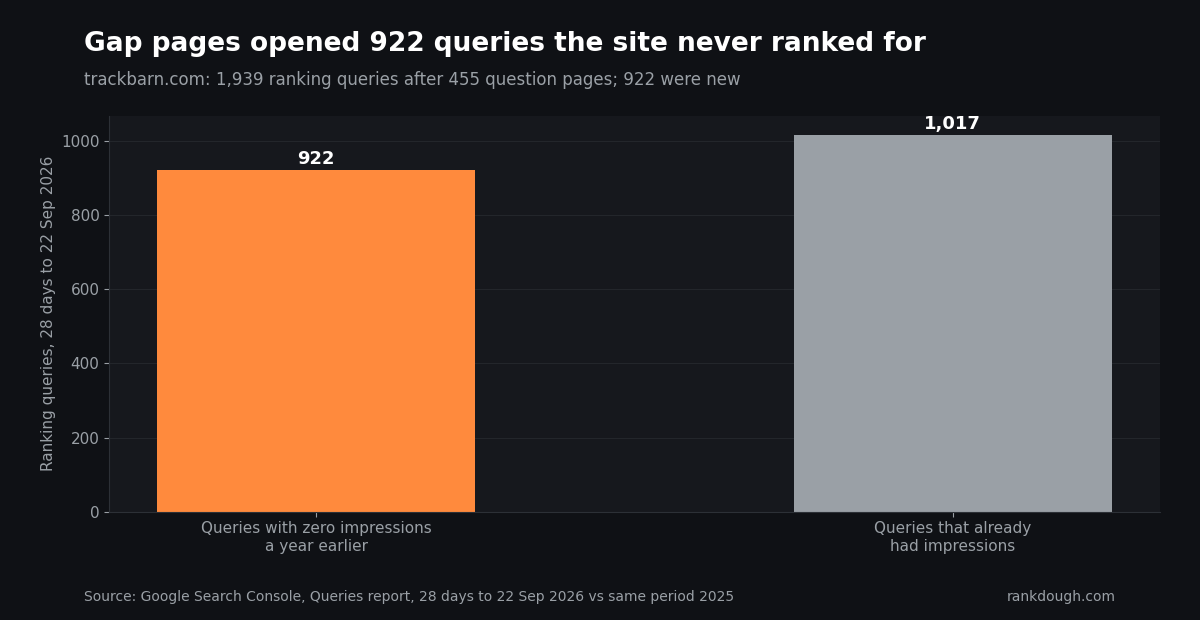
Source: Google Search Console, trackbarn.com, Queries report, 28 days to 22 Sep 2026 versus same period 2025
How does buyer distance decide what gets written?
Buyer distance is the number of decisions a searcher still has to make before they could buy from the client. We score it 0 to 3 per question, before the research brief, because once a brief exists the page gets written. That is how content operations work and pretending otherwise wastes money.
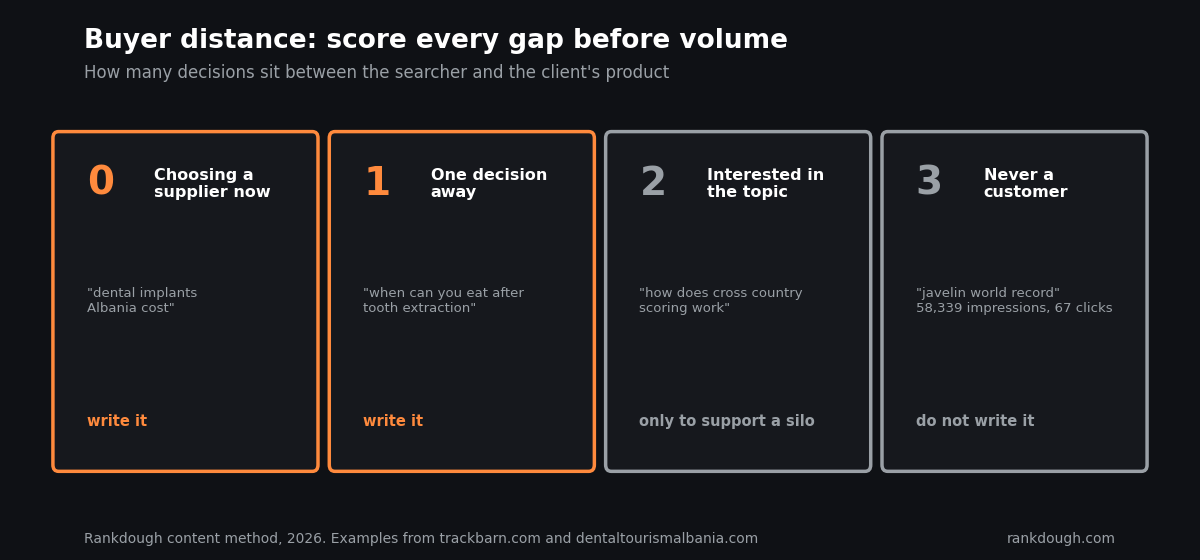
| Score | Searcher | Example | What I do |
|---|---|---|---|
| 0 | Choosing a supplier now | “dental implants Albania cost” | Write it, with a price block |
| 1 | One decision away | “when can you eat after tooth extraction” | Write it, with the next step on the page |
| 2 | Interested in the topic, not the product | “how does cross country scoring work” | Only if the silo needs it; measure it as a citation asset |
| 3 | Never a customer | “javelin world record” (58,339 impressions, 67 clicks) | Do not write it |
Table 1. Buyer distance applied to real queries from trackbarn.com and dentaltourismalbania.com.
This score explains the one result in our data that content quality cannot. On Dental Tourism Albania the aftercare pages sit at positions 1 and 2 and the homepage gained 93 estimated visits over the same period.
A patient who just had an extraction is one decision away from choosing a clinic. On TrackBarn the same template put pages at positions 3 to 6 and the homepage lost 43% of its clicks year on year.
Parents asking how far middle-school cross country runs do not buy poles. Same system. Different distance.
Source: Ahrefs top pages, dentaltourismalbania.com, 1 Jul vs 22 Sep 2026; Google Search Console, trackbarn.com, Pages report, 28 days to 22 Sep 2026 vs 2025
What makes the filled gap useful rather than just present?
Google’s guidance on Google Search Central, creating helpful, reliable, people-first content asks whether a reader leaves feeling they learned enough to get what they came for. We turn that into a test that runs twice, before and after writing.
- Before the brief: one sentence saying what the reader will be able to judge after reading. “After this page the reader can tell whether a 48-hour turnaround is realistic for 12 jerseys.” If I cannot write that sentence, I do not brief the page.
- After generation: every promise is checked against the text, point by point, by a pass that did not write it.
- No hedge without a number. “Typically”, “usually” and “depends” are allowed only in a sentence that also carries a figure.
- When the figure does not exist, the page says so. A visible gap costs a bit of credibility. An invented price costs all of it. On a medical page it turns into a one-star review, which is why the implant pricing brief I wrote for Dental Tourism Albania asked for every single price to be verified before anything went live.
Source: Google Search Central, creating helpful, reliable, people-first content; Rank Dough content system value-promise check (19 Feb 2026); client brief recording, implant pricing article, 2026
What did the method produce?
Two results from the last six months, windows stated.
- trackbarn.com: 455 question pages from one keyword export, ranking for 1,939 queries in the 28 days to 22 September 2026. 922 of those had zero impressions a year earlier. Page-one keywords in Ahrefs went from 103 to 1,667 in twelve months.
- proplayerteam.com: an FAQ hub built on the same atomic-answer rules straight after the Shopify migration was ranking for 81 keywords within the first month, with 150 pages live, while the rest of the site was still climbing out of the migration dip.
And the honest line. Roughly a third of the TrackBarn pages sit at buyer distance 3.
They rank. They were not worth writing.
The score now runs before the brief, not after the data comes in. The full walk through that project, export to published pages, is in the worked example.
Source: Google Search Console, trackbarn.com; Ahrefs keywords history, trackbarn.com, Sep 2025 to Sep 2026; monthly client update recording, ProPlayerTeam, April 2026
Why does this matter more now than two years ago?
Because the search results page answers the easy questions itself. A definition, a distance, a date: Google shows it above the results and an AI assistant says it in one line.
The click for those is gone, and I have the numbers to show it. TrackBarn’s mobile position went from 12.5 to 6.2 in a year while its click rate fell from 1.92% to 0.49%. Rankings up, clicks down, same site.
What still earns a visit is the question the results page cannot answer because the data is not public: your price, your turnaround, your minimum, what breaks and how you fix it. Those are the gaps. They are also the only pages a machine can quote with your name attached, which is where proprietary data and AI citations picks up.
Source: Google Search Console, trackbarn.com, Devices report, 28 days to 22 Sep 2026 vs 2025
What should you run on your own export this week?
- Open the client’s site and list what it sells, with prices and turnaround. Keep that list beside the export.
- Delete every generic term from the article list. Move them to collections.
- For each remaining question, write the buyer distance beside it. Cut the 3s.
- For each 0 and 1, write the one figure the page will give that no competitor gives. If it is not in your data or a checkable source, mark the gap as open and move on.
- Write the reader outcome in one sentence. Then brief.
What goes into the page once the gap is chosen, and how many figures it needs, is in information gain. The paragraph-level test every page passes before it ships is on the non-commodity content page. See what you think.
FAQ
What is the difference between a content gap and a keyword gap?
A keyword gap is a term a competitor ranks for and you do not. A content gap is a buyer question no page answers with a specific figure. Keyword gaps come from a tool. Content gaps come from reading the answers and spotting the number that is missing.
Should every gap in the report be filled?
No. Score each one on buyer distance first. Questions at 0 or 1 get a page. Distance 3 never does, whatever the volume, because the searcher will not buy.
Why do generic terms become collection pages rather than articles?
A generic term has no single answer, so an article built from it turns into a definition and a list. That page is interchangeable and the first to be replaced by an AI summary. A collection page with products, prices and filters is what the term actually wants.
How many competitors should be scraped?
Three is enough to find the consensus. What all three say gets one sentence in your page. What none of them says with a figure is the gap.
What happens when the figure for a gap does not exist?
The page says so, or waits. I never fill a gap with an estimate dressed as a fact. On a medical or pricing page an invented number becomes a bad review.
Sources
- Google Search Console, trackbarn.com, Queries, Pages and Devices reports, 28 days to 22 September 2026 versus same period 2025
- Google Search Central, creating helpful, reliable, people-first content
- Ahrefs, Content Gap tool
