
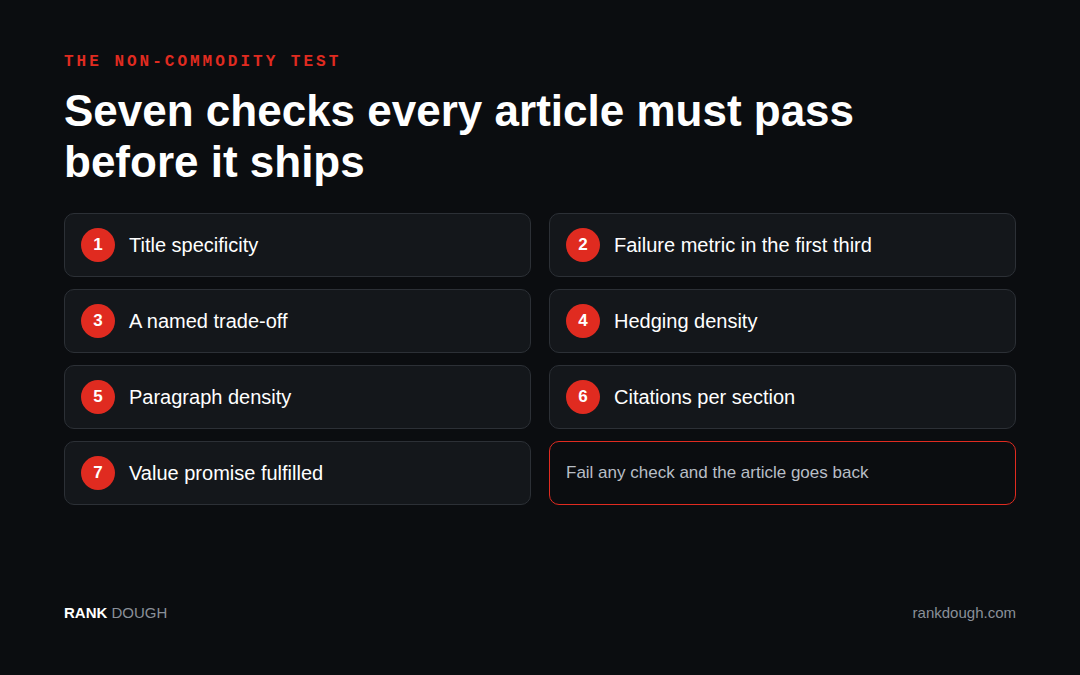
TL;DR: Before an article is written, it has to pass a non-commodity test: does the title and every section say something a generic article on the topic would not? The test became an automated compliance guard on 29 May 2026. It exists because a page that repeats the consensus is interchangeable, and interchangeable pages are the first ones AI answer systems stop citing. This article sets out the test, the seven checks behind it, how it changed the titles on dentaltourismalbania.com, and what is being measured to prove it.
What commodity content is, and why it stops earning
Commodity content is any page whose information could be swapped for a competitor’s without the reader noticing. “Everything you need to know about dental implants” is commodity. So is “a complete guide to cross-country training”. They rank when nothing better exists and drop the moment something specific appears.
The economics changed in 2025. AI answer systems now compress the consensus on a topic into a paragraph and cite one or two sources for it. If ten pages say the same thing, one is cited and nine are not. The cited page is the one that added a figure, a threshold, a counter-intuitive claim or a named trade-off. The other nine are the raw material the answer was built from, and they earn nothing for it.
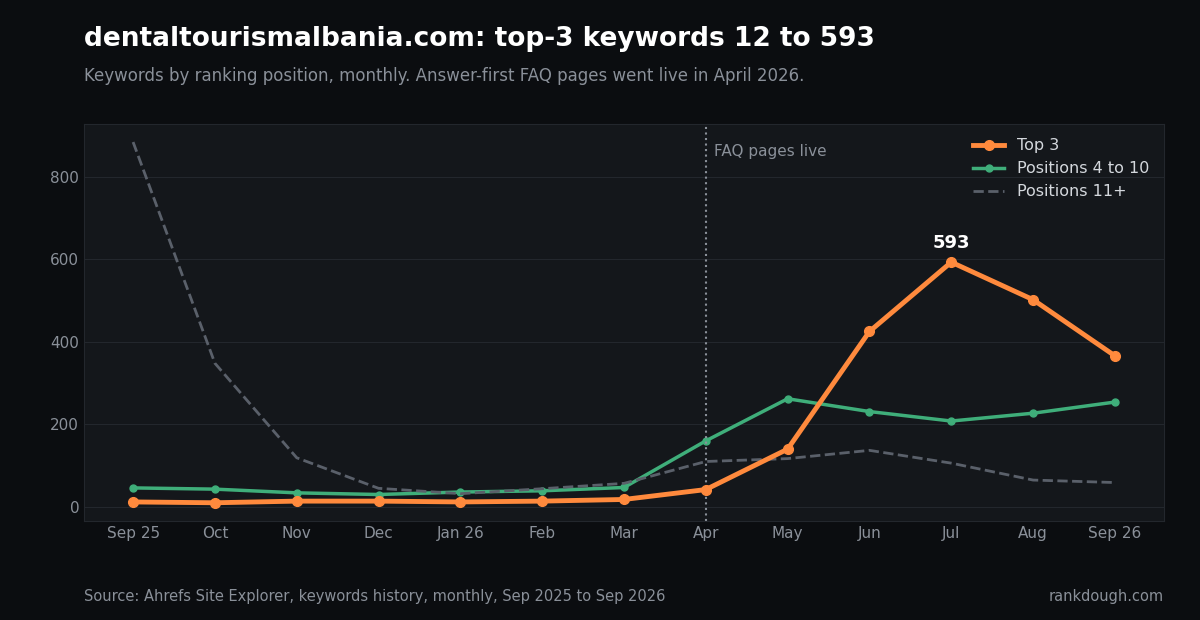
Ahrefs shows the effect on dentaltourismalbania.com from the other direction. In September 2025 the site had 884 keywords ranking at position 11 or worse, almost all on generic dental pages. By September 2026 it had 59. The generic long tail did not get pushed down; it got replaced by pages that hold positions 1 to 3, which went from 12 to 593 at peak.
The seven checks in the non-commodity guard
The guard runs against the finished article, not the brief. Each check returns a pass, a flag with the failing sentence, or a fail that sends the article back.
- Title specificity. The title names a distinction, a number, a mistake or a decision. “Choosing an implant dentist: four questions most patients never ask” passes. “How to choose an implant dentist” fails.
- Failure metric. Somewhere in the first third the article states what goes wrong when the reader gets this decision wrong, with a figure. Not “problems can arise” but a cost, a delay or a rate.
- Named trade-off. At least one section presents a real choice with something lost on each side. Articles where every option is good are commodity by definition.
- Hedging density. Sentences built on “may”, “might”, “can sometimes” are counted. Above a threshold per section the article is flagged.
- Paragraph density. No paragraph over four sentences without a figure, a list or a table in it. Long uninterrupted prose is where generic text hides.
- Citations per section. Every section except the summary blocks carries a source line. A claim with no source is treated as a claim that any page could make.
- Value promise fulfilled. The brief states what the reader will be able to do after reading. The guard checks each promise against the text, point by point.
Checks 4 and 5 were the ones that caught the most. Early articles passed on structure and failed on hedging: correct facts, softened into interchangeability by “generally” and “in most cases”.
What the test did to titles
The most visible change is in the titles of pages written after 29 May. Before the guard, a brief on screwless dental implants produced the title “Screwless dental implants: what are they?”. After the guard, the same brief produced “Screwless dental implants don’t exist: what clinics mean when they say it”. The second title makes a claim a generic article would not make, and the article has to earn it.
On the same site: “Choosing a dentist for implants” became “Choosing an implant dentist: when ‘specialist’ doesn’t mean expert”. A jersey-stitching page on a sports client became “NBA and NFL jersey stitching: what’s the real difference?” rather than a guide to jersey types. Each title states the specific thing the article knows.
The guard also rewrote the opening pattern. A commodity opening reassures: “Recovery after an extraction is usually straightforward.” A non-commodity opening commits: it states the hours, the day the socket closes, the sign that means something is wrong. That opening is the retrievable unit, so the test and the answer-first rule reinforce each other.
Where the evidence stands
Two things are measured and one is not yet.
Measured: the position distribution on dentaltourismalbania.com. Keywords in the top 3 rose from 18 in March 2026 to 593 in July. The long tail at position 11 and worse fell from 884 to 59 over twelve months. Both moves happened as generic pages were replaced by specific ones.
Measured: which pages hold positions 1 to 2 in the September top pages report.
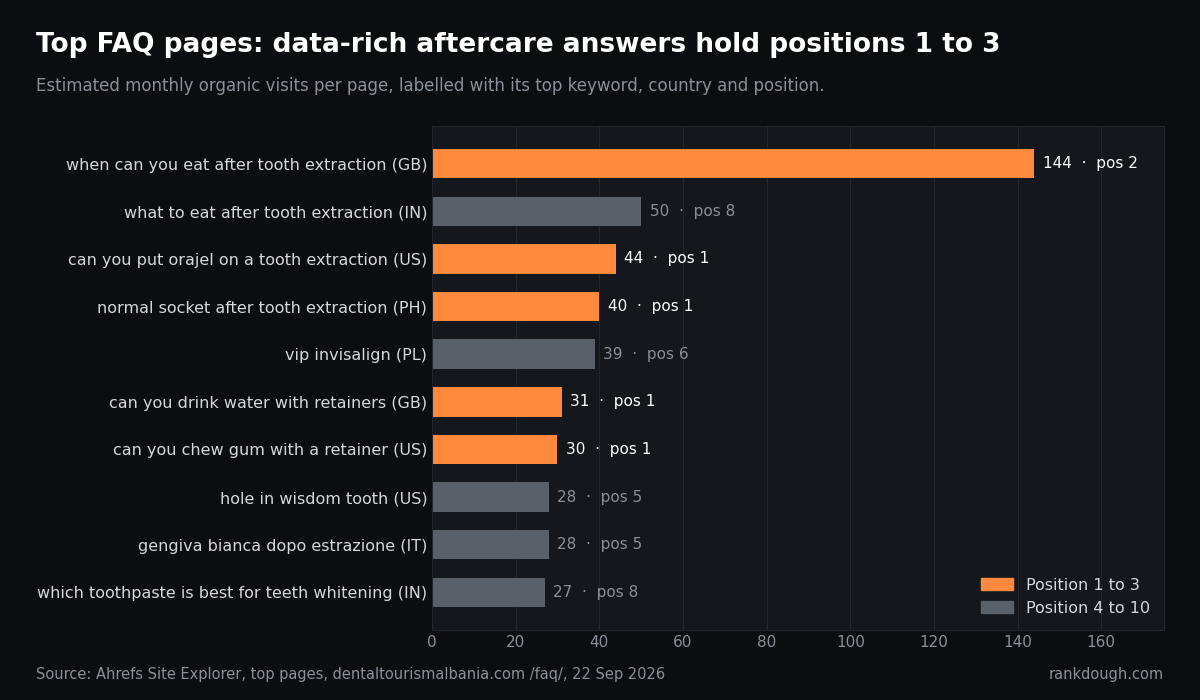
All six are pages whose title and opening make a specific claim: whether a gel is safe on a wound, whether water is safe with a retainer in, what a socket looks like at day three. None of the six is a general guide.
Not yet measured: a controlled comparison of pages written before the guard against pages written after, on the same silo, with three months of ranking data. That comparison is running now and will be published. Until then, the claim that the guard itself moves rankings is a working hypothesis supported by the two measured patterns above, and I present it as such.
How to run the test by hand
You do not need a compliance engine to apply the principle. Before writing, answer three questions in writing:
- What does this article know that the top three ranking pages do not? If the answer is nothing, do not write it.
- What is the one figure a reader would quote to a friend afterwards? Put it in the first sentence.
- What does the reader lose if they get this wrong? Say it, with a number, in the first third.
Then read the finished draft and delete every sentence that could appear unchanged on a competitor’s page. What survives is the non-commodity content. If less than half survives, the brief was too thin.
What this means for buyers of content
Ask for the titles of the last 20 pages your agency published. If most of them could be swapped with a competitor’s titles without anyone noticing, the pages are commodity, and they will be the first to lose citations. Then ask what test each page passed before it went live. “Our editors reviewed it” is not a test. A checklist with pass and fail conditions is.
Work with us: every article we write passes this test. See our content service, or the TrackBarn case study for the results.
FAQ
What is non-commodity content?
Content that states something a generic article on the same topic would not: a figure, a threshold, a named trade-off, a mistake with a cost. It is the content answer systems cite rather than summarise.
Does the test slow production down?
It removes articles before they are written, which speeds production up. The articles that pass take no longer to write than commodity ones; the brief is what changes.
Can the test be applied to existing pages?
Yes. Run the seven checks against the published HTML. Pages that fail on hedging and paragraph density can usually be fixed by editing; pages that fail on title and failure metric need a new brief.
Is the guard automated or manual?
Automated, running against the finished HTML after generation. Flags are returned with the failing sentence so an editor can act on each one.
What evidence supports the guard so far?
Top-3 keywords on dentaltourismalbania.com rose from 18 to 593 as generic pages were replaced by specific ones, and all six position-1 pages in September make a specific claim in their title. A controlled before-and-after comparison is in progress.
Sources
- Ahrefs Site Explorer, keywords history by position band, dentaltourismalbania.com, monthly, September 2025 to September 2026
- Ahrefs Site Explorer, top pages, dentaltourismalbania.com, 22 September 2026
- Rankdough content system build record, non-commodity compliance guard specification, 29 May 2026
