
Information gain is what a page adds beyond what the other pages ranking for the same query already say. We treat it as a count, not a feeling: five sourced figures per article, three of them in the first 30 percent, and every paragraph carrying a number, a named failure, a distinction or a claim against the consensus.
On dentaltourismalbania.com every FAQ page at position 1 to 3 opens with a figure. Every page at 8 or 9 opens with reassurance. That is the whole article in two sentences, but the data is worth a look.
TL;DR
When ten pages answer a question with the same facts, an AI answer compresses the lot and cites one, so I count what a page adds: five sourced figures per article, three in the first 30 percent, each a figure with a unit and a source. On the dental site every page at position 1 to 3 opens with a number and every page at 8 or 9 opens with the consensus. The site went from 12 to 593 top-3 keywords; I cannot prove the gain rule did that alone, but no page written before the rule holds position 1 today and every position-1 page was written after it.
How this was researched
The work behind the numbers, so you can judge them for yourself.
EFFORT
A rule tracked for months
The five-figure floor went in on 29 May 2026. We compared the dental site’s top pages in Ahrefs, position by position, against what each page opens with.
ORIGINALITY
Our rule, our data
The rule comes from our own content system and the ranking data from a client site we run.
SKILL
Run by an SEO, not a tool
Written by Roman Sadowski, who built the rule into the content system and reviews the pages it produces.
ACCURACY
Pattern, not proof
Two other rules landed in the same window, so the rise to 593 top-3 keywords can’t be put down to this rule alone.
The information gap series
- Content gap analysis that finds buyer questions, not keywords
- Information gain: one page wins when ten say the same thing (this page)
- Proprietary data: the facts an AI cannot write without you
- A content gap analysis on a real site, start to finish
What does information gain mean in practice?
Ten pages, same question, same facts. An engine has nothing to choose between them.
An AI answer squashes all ten into one paragraph and names one or two. Information gain is the measure of what one page adds to that pile.
Google’s guidance on Google Search Central, creating helpful, reliable, people-first content asks whether a page provides substantial value compared with the other results, which is the same question asked from the reader’s side.
For one writer, “add something new” is a fine instruction. For a system putting out hundreds of pages it is not checkable, so I made it a count.
A data point is a figure with a unit and a source I can name. “Implants are more affordable abroad” is a claim.
“Implants in Albania cost 60 to 80 percent less than in the UK” with the source under it is a data point. Five of those per article or the article goes back.
Source: Rank Dough content system, information-gain rule, raised from three to five data points on 29 May 2026
Why is the floor five, and why do three come early?
The floor used to be three. In May I went through the dental aftercare pages and the pattern was hard to miss.
The pages holding positions 1 to 3 had figures in the opening. The pages drifting from position 2 down to 5, 7, 9 had their figures, if they had any, buried in the middle behind an opening that told the reader not to worry.
So two things changed on 29 May. The floor went to five.
And I added a placement rule: three of the five sit in the first 30 percent of the text, because that is what a reader sees before they decide to stay and that is what an answer system lifts. A figure at the bottom of 1,500 words is invisible to both.
The check runs after generation on the finished HTML by a pass that did not write the page. Short count or wrong placement, the article comes back with the section flagged.
The rule itself is written up in the five-data-points article. This page is about what it did.
Source: Rank Dough content system build record, 29 May 2026
What does the ranking data show?
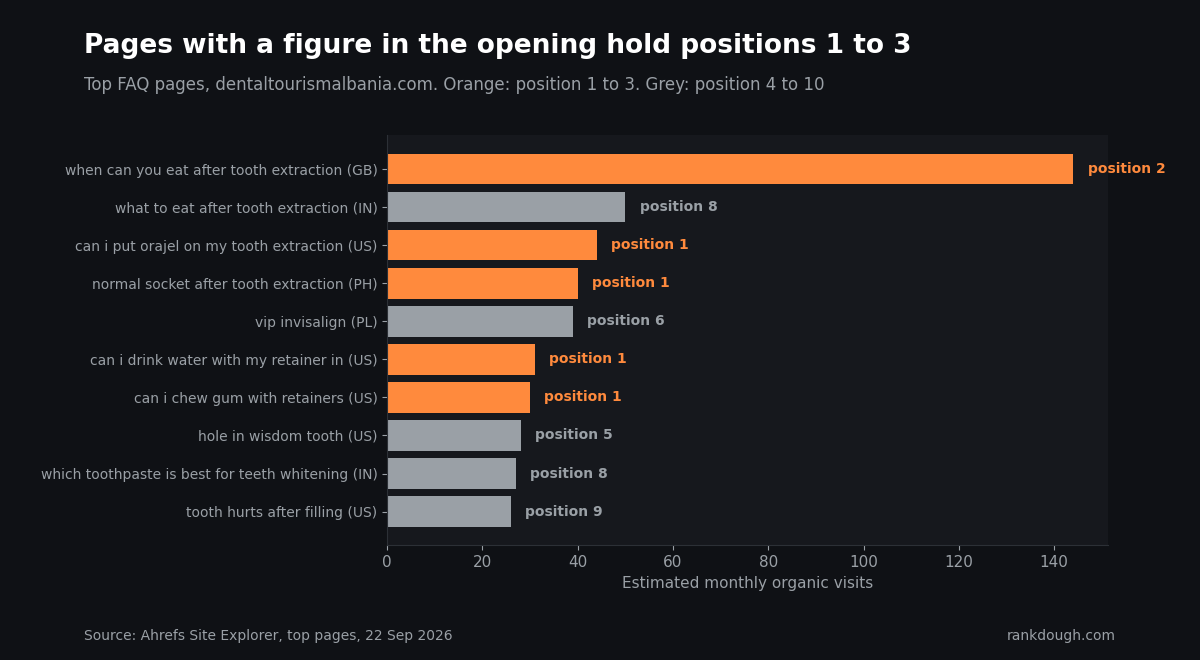
| Page | Position | Opens with | Monthly visits (est.) |
|---|---|---|---|
| when can you eat after tooth extraction | 2 (GB) | hours and a day count | 144 |
| can I put orajel on my tooth extraction | 1 (US) | a yes/no and a timing | 44 |
| normal socket after tooth extraction | 1 (PH) | what day 3 looks like | 40 |
| can I drink water with my retainer in | 1 (US) | a yes/no and a reason | 31 |
| what to eat after tooth extraction | 8 (IN) | general reassurance | 50 |
| which toothpaste is best for teeth whitening | 8 (IN) | general reassurance | 27 |
| tooth hurts after filling | 9 (US) | general reassurance | 26 |
Table 1. Ahrefs top pages, dentaltourismalbania.com, 22 Sep 2026. “Opens with” is my reading of each page’s first paragraph.
It holds across the top ten. Every page at 1 to 3 gives a number or a straight answer in its opening.
Every page at 8 or 9 opens with the consensus. The three in that second group were written before the floor went up and are being rewritten now.
I will publish the before and after once it has three months of data behind it. Not before.
Source: Ahrefs Site Explorer, top pages, dentaltourismalbania.com, 22 September 2026
Did the rule move the site, or did something else?
Top-3 keywords went from 12 in September 2025 to 593 at the July 2026 peak. The long tail at position 11 or worse fell from 884 to 59 in the same year.
I am not going to tell you the information-gain rule did that by itself. The answer-first opening rule and the five-FAQ minimum went in during the same window and I cannot pull the three apart on this data.
What the data does support: no page generated before the floor went up holds a position-1 ranking on the site today, and every position-1 page was generated after it. That is a correlation with a mechanism behind it. I will call it that and nothing more.
Source: Ahrefs Site Explorer, keywords history by position band, dentaltourismalbania.com, monthly, Sep 2025 to Sep 2026
Where do the figures come from?
A rule that demands five figures is an invitation to make them up, unless you control where they come from. Every article in our system has a research brief produced for that one question, and the brief is the only place facts may come from. The writer sees the relevant passages for the section it is writing, not the whole document, so the figures land where they belong instead of drifting to the end.
Each figure carries a source line under the section that uses it. The article ends with at least four external references.
The client’s own domain is never one of them. And when the brief has no figure for a claim, the page says “no public data” instead of inventing one.
That refusal is the single thing that separates this from every mass-content tool I have tested, and it is the reason a marketplace page can sit above the NHS on a medical query.
Source: Rank Dough content system, sourced-figures and references rules, enforced from 8 June 2026
How does the rule change what gets written?
The five-point floor kills a whole category of article before it starts. “Everything you need to know about dental implants” cannot meet it, because no brief on a topic that wide has five figures that belong in one opening.
“How much do implants cost in Albania compared with the UK” meets it in the first paragraph. So the rule pushes every idea toward a question specific enough to answer with numbers, which happens to be the kind of question a buyer asks late in a decision. The gap-finding method that produces those questions is in content gap analysis.
It changes titles too. “Screwless dental implants: what are they?” became “Screwless dental implants don’t exist: what clinics mean when they say it.” The second title makes a claim the article then has to earn. The seven checks behind that are on the non-commodity test page.
What does a page with no gain look like, honestly?
I know because I have published them. The TrackBarn page on the javelin world record is one.
It has a number, it ranks at position 8, it took 58,339 impressions in 28 days, and it adds nothing a reader could not get from the results page itself, which is why 67 people clicked. Gain is not just having a figure.
It is having a figure the other pages do not, that a reader needs to act. That page has the first and not the second. It is on the prune list.
Source: Google Search Console, trackbarn.com, Pages report, 28 days to 22 Sep 2026
What should you check on your own site?
- Open your five best-ranking informational pages. Count figures with units in the first 30 percent. Fewer than three and the opening is prose, and prose loses extraction.
- Check where each figure came from. If you cannot name the source, neither can an answer engine, and it will cite a page that can.
- Compare your pages at 1 to 3 with your pages at 6 to 10 on the same site. On both sites in this article the difference is figure density, not word count and not links.
- Once the figures are in, phrase them so an AI answer lifts them with your name attached. That is the next article.
FAQ
What counts as a data point for information gain?
A figure with a unit and a source I can name: a duration, a percentage, a price, a count, a measurement. Qualitative claims and rounded generalities do not count.
Why three figures in the first 30 percent?
That is what a reader sees before committing and what an answer system extracts from. Figures placed later are invisible to both. The rule came from watching pages with buried figures drift from position 2 to 5 to 9.
Does more than five help?
Not by itself. Five is the floor. Past it, placement and sourcing matter more than count, and padding with figures the reader does not need hurts the page.
Did the information-gain rule cause the rise to 593 top-3 keywords?
I cannot prove it. The answer-first rule and the five-FAQ minimum landed in the same window. What I can show is that every position-1 page on the site was generated after the floor went up.
How is the count enforced?
An independent check reads the finished HTML, counts sourced figures and where they sit, and sends the article back if it fails. The writer never certifies its own output.
Sources
- Ahrefs Site Explorer, top pages, dentaltourismalbania.com, 22 September 2026
- Google Search Central, creating helpful, reliable, people-first content
- Ahrefs, keyword cannibalisation
