
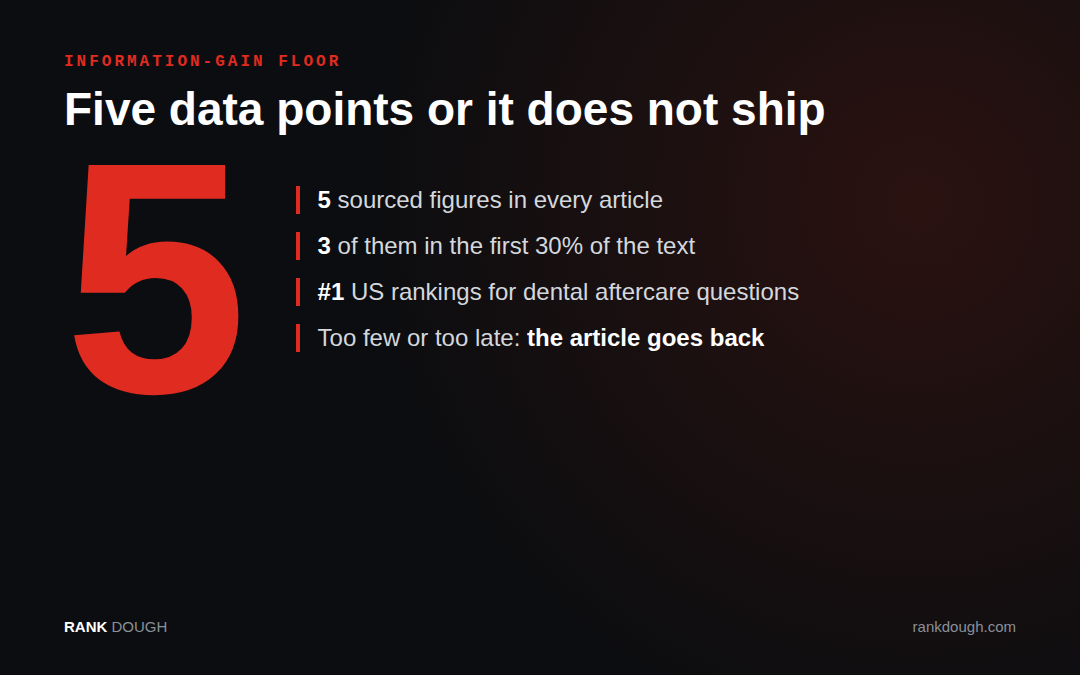
TL;DR: Every article in my content system must contain at least five concrete data points, with three of them in the first 30 percent of the text. I raised the floor from three to five on 29 May 2026. The pages that meet it hold position 1 in the United States for queries such as “can I put orajel on my tooth extraction” and “can I drink water with my retainer in”, and position 2 in the United Kingdom for “when can you eat after tooth extraction” against NHS and Bupa content. This article explains the rule, why the threshold sits where it does, and what the ranking data shows.
What information gain means in practice
Information gain is the amount a page adds beyond what the other pages ranking for the same query already say. The idea appears in a Google patent on information gain granted in 2022, and Google’s own guidance on helpful content asks whether a page provides original information and substantial value compared with other results. AI answer systems apply the same logic when they choose which passage to cite: a page that repeats the consensus is interchangeable; a page that adds a figure, a threshold or a measured outcome is worth naming.
For a content system that produces hundreds of pages, “add something new” is not an instruction anyone can check. A count is. So the rule is numeric: five data points per article, three of them early. A data point is a figure with a unit and a source. “Most patients recover quickly” is not one. “Most patients return to a normal diet within 7 to 10 days, according to the Oral Health Foundation” is.
Why the threshold is five, and why three come early
The original floor was three data points per article. In May 2026 I reviewed dental aftercare pages that ranked on page one but did not hold a top-3 position. The pattern was consistent: the pages had one or two figures buried in the middle, and an opening built on reassurance. Pages with figures in the opening held their positions through the summer; pages without them drifted to positions 5 to 9.
So the rule changed in two ways on 29 May 2026. The floor rose to five. And a placement condition was added: three of the five must appear in the first 30 percent of the article, because that is the part a reader sees before deciding to stay and the part an answer system extracts from. A figure at the bottom of a 1,500-word page is invisible to both.
The compliance checker counts data points after generation. If the count is short or the placement is wrong, the article goes back to the writer with the section flagged. The writer does not get to declare the article compliant.
What the top pages look like when the rule holds
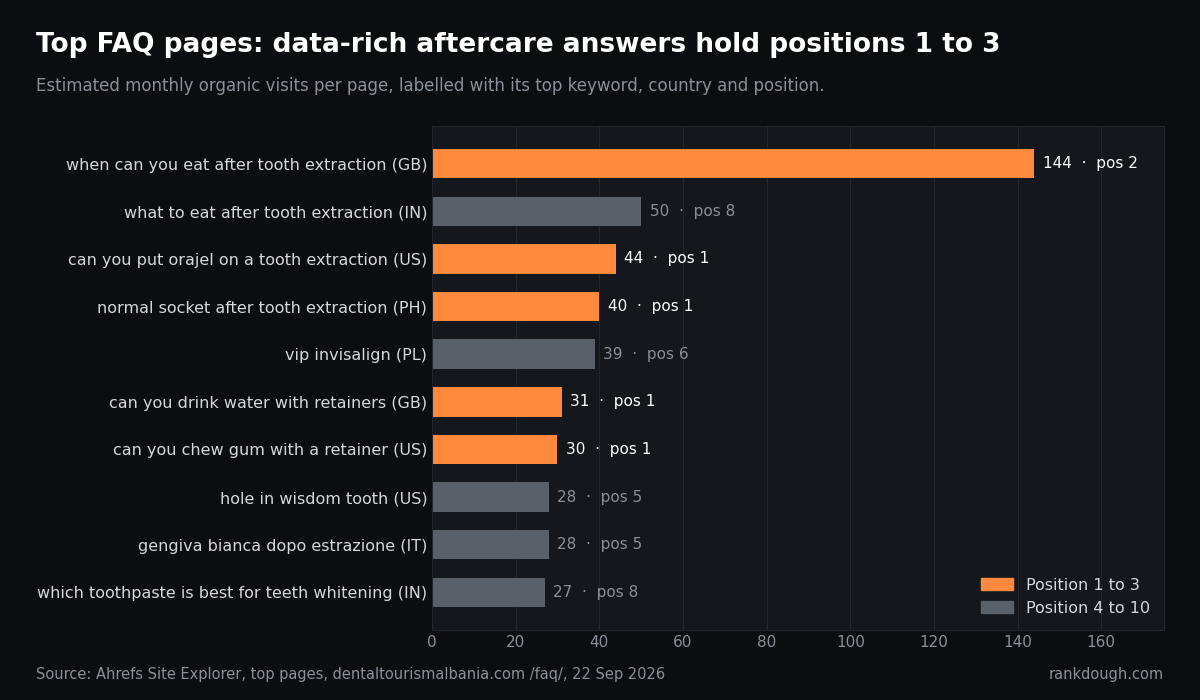
The Ahrefs top pages report for dentaltourismalbania.com on 22 September 2026 shows the effect. Of the ten highest-traffic FAQ pages, six hold position 1 to 3. All six are aftercare questions with specific answers: hours before eating, what a normal socket looks like at day three, whether a gel can be applied to a wound, whether water is safe with a retainer in.
- “When can you eat after tooth extraction”: position 2, United Kingdom, 144 estimated visits a month
- “Can I put orajel on my tooth extraction”: position 1, United States, 44 visits
- “Normal socket after tooth extraction”: position 1, Philippines, 40 visits
- “Can I drink water with my retainer in”: position 1, United States, 31 visits
- “Can I chew gum with retainers”: position 1, United States, 30 visits
- “Can you drink water with white strips on”: position 1, United States, 18 visits
The pages sitting at positions 8 to 9 in the same report are the ones with softer answers: “what to eat after tooth extraction” (position 8), “which toothpaste is best for teeth whitening” (position 8), “tooth hurts after filling” (position 9). Those were written before the floor rose and are scheduled for a rewrite under the current rule. The comparison after the rewrite will be published.
Where the data points come from
A rule that demands five figures per article invites fabrication unless the source of those figures is controlled. In this system it is. Every article has a research brief generated from a deep-research prompt specific to that question. The brief is the only permitted source of facts. The writer retrieves the relevant chunks of the brief rather than the whole document, so it sees the figures that matter for the section it is writing and nothing else.
Each figure then carries a source line under the section that uses it, and the article ends with a references list of at least four external sources. Low-authority sources are rejected at brief stage. The client’s own domain is never cited as a source. A page on a dental marketplace that cites the marketplace is not adding information; it is adding a link.
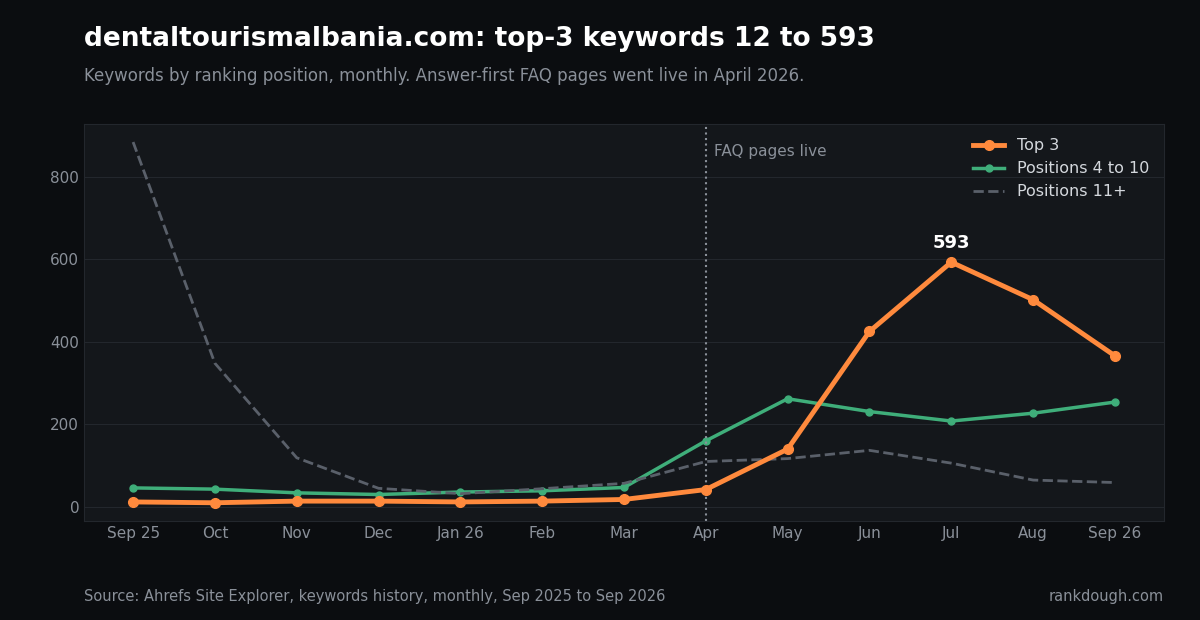
This is the part that took longest to make reliable. The references logic went through 14 builds before the source lines appeared consistently in the published HTML. The rule was specified on day one; it held from June. The pages published after that date are the ones now sitting at positions 1 and 2.
How the rule changes what gets written
The five-point floor kills a category of article before it starts. “Everything you need to know about dental implants” cannot meet it, because the brief for a topic that broad has no five figures that belong in one opening. “How much do dental implants cost in Albania compared with the UK” meets it in the first paragraph. So the rule pushes every idea toward a question specific enough to answer with numbers, which is also the kind of question a buyer asks late in their decision.
It also changes titles. A title that promises a figure (“four questions most patients never ask”, “the 48-hour rule”) is a title the system can deliver on. A title that promises a feeling is not.
What to check on your own site
- Open your five best-ranking informational pages. Count figures with units in the first 30 percent. Fewer than three means the opening is prose, and prose loses extraction.
- Check where each figure came from. If you cannot name the source, neither can an answer system, and it will cite a page that can.
- Compare pages at position 1 to 3 with pages at 6 to 10 for the same site. On the two sites in this article the difference is figure density, not word count or backlinks.
Work with us: the five-data-point floor applies to every article in our content service.
FAQ
What counts as a concrete data point?
A figure with a unit and an identifiable source: a duration, a percentage, a price, a count, a measurement. Qualitative claims and rounded generalities do not count.
Why three in the first 30 percent rather than spread through the article?
The first 30 percent is what a reader sees before committing and what an answer system extracts from. Figures placed later are invisible to both.
Does more than five help?
Not by itself. Five is the floor, not a target. Beyond it, placement and sourcing matter more than count.
How is the count enforced?
An independent checker reads the finished HTML, counts sourced figures and their positions, and returns the article if it fails. The writer does not self-certify.
What happens to older pages written under the three-point floor?
They are being rewritten under the five-point rule, and the before-and-after ranking comparison will be published once it has three months of data.
Sources
- Ahrefs Site Explorer, top pages, dentaltourismalbania.com, 22 September 2026, compared with 1 July 2026
- Ahrefs Site Explorer, keywords history by position band, dentaltourismalbania.com, monthly, September 2025 to September 2026
- Google patent US20220374460A1, “Contextual estimation of link information gain”, Google LLC, published 2022
